Tuesday, September 10, 2019

Hurricanes and Climate Change - The Climate Change Alarmists Are Wrong Again

Judith Curry is a world renowned climate scientist.  Here is a link to a recent paper of hers titled "Hurricanes and Climate Change".

JC's view conflicts sharply with the alarmist statements you hear from the media, politicians, and many "climate scientists".  I have put the latter in quotes because so many of them have no credible reason for their alarmist position; hence are not scientists in the true sense.

Some excerpts from JC's paper follow.
-----------------------------------
Executive summary

This Report assesses the scientific basis for projections of future hurricane activity. The Report evaluates the assessments and projections from the Intergovernmental Panel on Climate Change (IPCC) and recent national assessments regarding hurricanes. The uncertainties and challenges at the knowledge frontier are assessed in the context of recent research, particularly with regards to natural variability. The following four questions frame this Report:

1 Is recent hurricane activity unusual?

In the North Atlantic, all measures of hurricane activity have increased since 1970, although comparably high levels of activity also occurred during the 1950’s and 1960’s. Geologic evidence indicates that the current heightened activity in the North Atlantic is not unusual, with a ‘hyperactive period’ apparently occurring from 3400 to 1000 years before present. Prior to the satellite era (1970’s), there are no reliable statistics on global hurricane activity. Global hurricane activity since 1970 shows no significant trends in overall frequency, although there is some evidence of a small increase in the number of major hurricanes.

2 Have hurricanes been worsened by man-made global warming?

Any recent signal of increased hurricane activity has not risen above the background variability of natural climate variations. At this point, there is no convincing evidence that man-made global warming has caused a change in hurricane activity.

3. Have hurricane landfall impacts been worsened by man-made global warming?

Of recent impactful U.S. land-falling hurricanes, only the rainfall in Hurricane Harvey is unusual in context of the historical record. Warmer sea surface temperatures are expected to contribute to an overall increase in hurricane rainfall, although hurricane induced rainfall and flooding is dominated by natural climate variability. Storm surge risk is increasing slightly owing to the slow creep of sea level rise. The extent to which the recent increase in ocean temperatures and sea level rise can be attributed to man-made global warming is disputed. The primary driver for increased economic losses from land-falling hurricanes is the massive population buildup along coastlines.

4. How will hurricane activity change during the 21st century?

Recent assessment reports have concluded that there is low confidence in projections of future changes to hurricane activity. Any projected change in hurricane activity is expected to be small relative to the magnitude of natural variability in hurricane activity.
----------
Over the years, the way that hurricanes have been observed has changed radically. As a result, many hurricanes are now recorded that would have been missed in the past. Furthermore, satellites are now able to continually assess wind speeds, thus recording peak wind speeds that may have been missed in pre-satellite days. Unfortunately, temporally inconsistent and potentially unreliable global historical data hinder detection of trends in tropical cyclone activity.
----------
While an increase in hurricane intensity has long been hypothesized to occur as global sea surface temperatures increase, identification of any significant trend in the hurricane data is hampered by a short data record and substantial natural variability.
----------
A positive rate of hurricane intensification has been identified in recent decades in the Atlantic. Whether this trend is associated with natural variability or warming is unknown. Global data on rates of hurricane intensification is ambiguous.
----------
In recent decades, the Northern Hemisphere Pacific Ocean has seen a poleward migration in hurricane track location and location of maximum intensity, and also a slowing of hurricane motion. This migration has been attributed primarily to natural variability of the ocean circulations.
----------
Outside the North Atlantic, and particularly in the Southern Hemisphere, the historical data sets are fairly meager and of questionable quality, particularly with regards to intensity. There is no evidence of trends that exceeds natural variability.
----------
All measures of Atlantic hurricane activity show a significant increase since 1970. However, high values of hurricane activity (comparable to the past two decades) were also observed during the 1950’s and 1960’s, and by some measures also in the late 1920’s and 1930’s.
----------
There has not been a timeline or synthesis of the Atlantic hurricane paleotempestology results for the past five thousand years, either regionally or for the entire coastal region. However, it is clear from these analyses that significant variability of landfall probabilities occurs on century to millennial time scales. There appears to have been a broad hyperactive period from 3400 to 1000 years B.P. High activity persisted in the 26 Gulf of Mexico until 1400 AD, with a shift to more frequent severe hurricane strikes from the Bahamas to New England occurring between 1400 and 1675 AD. Since 1760, there was a gradual decline in activity until the 1990’s.
----------
3.5 Conclusions

Analyses of both global and regional variability and trends of hurricane activity provide the basis for detecting changes and understanding their causes.

The relatively short historical record of hurricane activity, and the even shorter record from the satellite era, is not sufficient to assess whether recent hurricane activity is unusual for the current interglacial period. Results from paleotempestology analyses in the North Atlantic at a limited number of locations indicate that the current heightened activity is not unusual, with a hyperactive period apparently occurring from 3400 to 1000 years before present.

Global hurricane activity since 1970 shows no significant trends in overall frequency. There is some evidence of increasing numbers of major hurricanes and of an increase in the percentage of Category 4 and 5 hurricanes, although the quality of intensity data in some regions prior to 1988 is disputed.

In the North Atlantic, all measures of hurricane activity have increased since 1970, although comparably high levels of activities also occurred during the 1950’s and 1960’s.
----------
The observational database (since 1970 or even 1850) is too short to assess the full impact of natural internal variability associated with large-scale ocean circulations. Paleotempestology analyses indicate that recent hurricane activity is not unusual. Given the limited data record and its quality, there is no evidence of any changes in global or regional hurricane activity that exceeds natural variability.
----------
With regards to the observed global warming of the oceans, it is clear that manmade contributions to atmospheric CO2 do not provide a complete explanation of this warming. Solar variations, volcanic eruptions and the large-scale ocean circulation patterns also have a substantial influence on temperature variations in the global oceans.
----------
Atlantic hurricane processes are influenced substantially by the natural modes of ocean circulation variability in the Atlantic, notably the Atlantic Multidecadal Oscillation and the Atlantic Meridional Mode.
----------
Hurricanes in the Atlantic and Pacific are influenced substantially by the natural modes of ocean circulation variability in the Pacific. These modes include ENSO and Modoki, and also the Pacific Decadal Oscillation and the North Pacific Gyre Oscillation.
----------
Global climate models are currently of limited use in hurricane attribution studies. High-resolution models used to simulate individual hurricanes are being used to perform controlled experiments that focus on specific events and the complexities of relevant physical processes. However, definitive conclusions regarding the impact of man-made warming on hurricanes cannot be determined from these simulations, given the current state of model development and technology.
----------
In summary, there is no observed trend in hurricane activity that has risen above the background variability of natural processes. It is possible that man-made climate change may have caused changes in hurricane activity that are not yet detectable due to the small magnitude of these changes compared to estimated natural variability, or due to observational limitations. But at this point, there is no convincing evidence that man-made global warming has caused a change in hurricane activity.
----------
U.S. land-falling hurricanes show substantial year-to-year and decadal variability, associated primarily with ENSO and the Atlantic Multi-decadal Oscillation. Over the last century, there is a slight overall negative trend in the total number of hurricanes and major hurricanes striking the U.S. The number of major hurricanes striking the U.S. in recent decades is lower than the 1930’s, 1940’s and 1950’s. During the period 2006-2016, no major hurricanes struck the continental U.S.
----------
No trend in Caribbean landfalls has been observed. ENSO and Atlantic Multidecadal Oscillation dominate the variability of Caribbean landfalls. Historical records show that the time span 1968–1977 was probably the most inactive period since the islands were settled in the 1620s and 1630s.
----------
There are substantial challenges in constructing a homogeneous global hurricane landfall data set. Since 1970, the global frequency of total and major hurricane landfalls shows considerable interannual variability, but no significant linear trend. There is substantial regional variability in hurricane landfalls, primarily associated with ENSO phase.
----------
Examination of the number and intensity of historical Texas land-falling hurricanes shows no relationship with surface temperatures in the Gulf of Mexico. Harvey’s extreme rainfall has been linked to unusually high temperatures in the Gulf of Mexico that were associated primarily with local ocean circulation patterns. It has been estimated that at most about 2 inches of Hurricane Harvey’s peak amount of 60 inches can be linked with man-made global warming.
----------
Hurricane Irma set several intensity records, although these have not been linked in any way to sea surface temperature or man-made global warming. Historical data of Florida land-falling major hurricanes indicate no trends in either frequency or intensity.
----------
Of the four hurricanes considered here, only the rainfall in Hurricane Harvey passes the detection test, given that it is an event unprecedented in the historical record for a continental U.S. landfalling hurricane. Arguments attributing the high levels of rainfall to near record ocean heat content in the western Gulf of Mexico are physically plausible. The extent to which the high value of ocean heat content in the western Gulf of Mexico can be attributed to manmade global warming is debated. Owing to the large interannual and decadal variability in the Gulf of Mexico (e.g. ENSO), it is not clear that a dominant contribution from manmade warming can be identified against the background internal climate variability.
----------
The climate model projections of 21st century surface temperature and sea level rise are contingent on the following assumptions [IPCC AR5 WG1 Section12.2.3]: 1. Emissions follow the specified concentration pathways (RCP). 2. Climate models accurately predict the amount of warming in 21st century. 3. Solar variability follows that of the late 20th century, which coincided with a Grand Solar Maximum. 4. Natural internal variability of ocean circulations does not impact temperature or sea level rise on these timescales. 5. Major volcanic eruptions are not considered. Each of these contingent assumptions, with the possible exception of natural internal variability, likely contributes to a warm bias in the 21st century climate model projections.
----------
On timescales at least to 2050, variations in hurricane activity are expected to be dominated by natural variability, relative to any secular warming trends. A forthcoming shift to the cold phase of the Atlantic Multidecadal Oscillation – on a time scale of a decade or so – would result in fewer major hurricanes, lower values of Accumulated Cyclone Energy and fewer landfalls striking Florida, the U.S. east coast and the Caribbean. At some point in the coming decades, we can also anticipate a shift in the Pacific Decadal Oscillation towards more frequent La Niña events, which are associated with more activity in the Atlantic but suppressed activity in the Pacific.
----------
8. Conclusions

Numerous assessments and reviews have been conducted of the possible role of manmade global warming on global and regional hurricane activity. Overall, the ‘consensus’ among scientists on the possible role of manmade global warming on hurricane activity has been essentially unchanged over the past 15 years.

This Special Report on Hurricanes and Climate Change is distinguished from recent assessments by a focus on hurricane aspects that contribute to landfall impacts, and an increased emphasis on paleotempestology and interpretation of natural variability. Arguments have been presented supporting the important and even dominant role that natural processes play in global and regional hurricane variations and change.

1. Is recent hurricane activity unusual? In the North Atlantic, all measures of hurricane activity have increased since 1970, although comparably high levels of activity also occurred during the 1950’s and 1960’s. Geologic evidence indicates that the current heightened activity in the North Atlantic is not unusual, with a hyperactive period apparently occurring from 3400 to 1000 years before present. Prior to the satellite era (1970’s), there are no reliable statistics on global hurricane activity. Global hurricane activity since 1970 shows no significant trends in overall frequency, although there is some evidence of increasing numbers of major hurricanes.

2. Have hurricanes worsened from man-made global warming?

Models and theory suggest that hurricane intensity and rainfall should increase in a warming climate. Convincing attribution of any changes to man-made global warming requires that a change in hurricane characteristics be identified from observations, with the change exceeding natural variability.

Any signal of recent increased hurricane activity has not risen above the background variability of natural climate variations. At this point, there is no convincing evidence that man-made global warming has caused a change in hurricane activity.

While there is much physically-plausible speculation among scientists regarding impacts of global warming on hurricanes, most of this speculation has weak justification when the observational record is examined in context of natural climate variability.

3. Have hurricane landfall impacts been worsened by man-made global warming?

Worldwide economic losses from landfalling tropical cyclones have increased in recent decades. In addition to the frequency and intensity of landfalling hurricanes, the following variables contribute to damage: horizontal size of the hurricane, forward speed of motion near the coast, storm surge and rainfall.

Of the recent impactful U.S. landfalling hurricanes, only the rainfall in Hurricane Harvey is unusual in context of the historical record of U.S. landfalling hurricanes. Warmer sea surface temperatures are expected to contribute to an overall increase in hurricane rainfall, although hurricane-induced rainfall and flooding is dominated by natural climate variability. Storm surge risk is increasing owing to the slow creep of sea level rise. The extent to which the recent increase in ocean temperatures and sea level rise can be attributed to man-made global warming is disputed. The primary driver for increased economic losses from landfalling hurricanes is the massive population buildup along the coasts.

4. How will hurricane activity change during the 21st century?

Recent assessment reports have concluded that there is low confidence in projections of future changes to hurricane activity. Any projected change in hurricane activity is expected to be small relative to the magnitude of natural variability in hurricane activity.

Decadal variability of hurricane activity is expected to provide much greater variability than the signal from global warming. In particular, a shift to the cold phase of Atlantic Multidecadal Oscillation (AMO) is anticipated within the next 15 years. All other things being equal (such as the frequency of El Niño and La Niña events), the cold phase of AMO harkens reduced Atlantic hurricane activity and fewer landfalls for Florida, the east coast and the Caribbean.

Substantial advances have been made in recent years in the ability of climate models to simulate the variability of hurricanes. However, inconsistent hurricane projections have emerged from modeling studies. Progress continues to be made, particularly with models that are coupled to the ocean. Apart from the challenges of simulating hurricanes in climate models, the amount of warming projected by climate models for the 21st century is associated with deep uncertainty. Hence, projections of future hurricane activity are contingent on the amount of predicted global warming being correct.

Sunday, September 08, 2019

A respected climate scientist's perspective on alarmist climate scientists

Judith Curry is a leading climate scientist.  Here is an excerpt from her blog concerning climate scientist alarmists.
-------------------------------------------
JC message to the ‘alarmism enforcers’

Well there’s probably a better chance of President Trump listening to me than there is of the climate scientists who are alarmism enforcers listening to me, but here goes anyways.
  • Your behavior is violating the norms of science, and in my opinion is unethical: 
  • failure to acknowledge uncertainty and low levels of confidence in much of the research surrounding hurricanes and climate change. 
  • cherry picking research that supports your personal narrative of alarm, without acknowledging disagreement among scientists and other research and assessment reports that do not support your narrative of alarm. 
  • misleading the public and policy makers as a result of the above two practices 
  • and last but not least, bullying other respected scientists who have different perspectives on evaluating the evidence.
The above is what happens when scientists become political activists. I hope I am not seeing signs of GFDL’s Tom Knutson becoming the latest bullying victim of these activist scientists.

Scientists are gonna do what scientists are gonna do. Short of plagiarism, fabrication, and falsification, it seems no one cares what they do. What astonishes me is that there is no pushback from their universities and professional societies on this unethical behavior. Instead these activists are actually rewarded by the universities and professional societies.

The damage that these activist scientists are doing to climate science and the public debate on climate change is incalculable.

Tuesday, September 03, 2019

Researchers from Public Health, Criminology, and Economics have different views on gun control

Here is a link to a paper, "Do Researchers from Different Fields have a Consensus on Gun Control Laws and do Registered Voters Agree with any of them?

The authors are:

Arthur Z. Berg, MD Associate Professor Emeritus, Department of Psychiatry, Harvard Medical School.

John R. Lott, Jr. President, Crime Prevention Research Center.

Gary A. Mauser Professor Emeritus, Department of Marketing, Simon Fraser University.

The paper surveys views from researchers in three fields - Public Health, Criminology, and Economics.  Researchers in Criminology and Economics tend to agree on what works.  Researchers in Public Health have very different views.  The latter also tend to use inappropriate statistical methods that make their results (and in my opinion, their views) problematic.

Here are some excerpts.
------------------------------------------
Executive Summary

Hundreds of millions of dollars go to firearms research on crime, suicides, and accidental
deaths, but the vast majority of the money, particularly government money, is being spent on
public health research. We got a response rate of over 43%, or 120, from the 277 researchers
we approached, and we found large statistically significant differences in the views of academic
researchers in criminology, economics, and public health on 33 different gun control policies for
both mass public shootings and murder will reduce crime and save lives. Our sample is much
larger than two surveys of 32 researchers by the New York Times. While none of our groups are
quite as supportive of gun control as reported by the Times, public health researchers come
closest.
  • We find that Economists and to a lesser extent criminologists rank order the efficacy of gun control policies in the opposite order that public health researcher do. Using the New York Times survey of registered voters shows that their rank order is random when compared to any group of experts.
  • Regarding proposals that can reduce mass public shootings, while public health researchers give a score of at least 5.5 on a 1 to 10 scale for two types of gun control regulations (gun and ammunition bans as well as universal background checks), criminologists and economists only give that high of a score to just one type of gun regulation (eliminating gun-free zones).
  • Regarding proposals that can reduce murder rates, while public health researchers give a score of at least 5.5 on a 1 to 10 scale for one type of gun control regulation (universal background checks), economists only give that high of a score to just one kind of gun regulation (eliminating gun-free zones).
  • As a group, criminologists are generally extremely skeptical of gun control regulations. In none of the broad overall categories of gun control do either group give a score of at least 3.0 on a 1 to 10 scale for Red Flag laws, gun bans, universal background checks, or licensing and regulations.
  • Economists are even more skeptical of gun control regulations. In none of the broad overall categories of gun control do either group give a score of at least 2.0 on a 1 to 10 scale for Red Flag laws, gun bans, universal background checks, or licensing and regulations.
----------
Here, we compare the views of public health researchers with those of criminologists and economists on a wide range of gun control policies. Specifically, we ask academics to assess the impact of these policies on mass public shootings and murder rates. Our survey examines a very broad range of topical gun control policies and issues.

It’s only natural for there to be a diversity of views across academic disciplines that differ fundamentally in their theoretical foundations and research methodologies. No one should be surprised that criminologists, economists, and public health researchers would disagree about how
to approach public policy. Economics is based on the “law of demand,” which holds that as
something becomes more costly, people do less of it. Applied to crime, this concept means that
crime will decrease as punishments become more severe or the probability of arrest and conviction
increases. In sharp contrast to criminologists and public health researchers, all empirical
work by economists on crime includes law enforcement as a key factor.

Statistical techniques also vary greatly across the groups, with much of public health research
still relying on purely cross-sectional evidence. By contrast, such evidence is almost unheard of
among economists in the last couple of decades. Economists would argue that cross-sectional
comparisons cannot properly account for all of the differences across places.
Economists are much more focused on issues such as substitutability in methods of committing
suicide or murder. They look at total suicide or murder rates, whereas public health researchers
focus heavily on firearm suicides and homicides. Economists would argue that even if firearm
suicides significantly declined after a particular gun control law, most or even all of the people
who would have used firearms might have picked another method of killing themselves.
Unlike most economists and criminologists, public health academics also see themselves as
more than just researchers. “Public health academics are expected not just to study problems,
but also to reduce them,” Hemenway and Miller (2019) note. “The dual mission of public health
academics is reflected by the mixture of academics, advocates, practitioners, and policymakers
who attend the annual American Public Health Association meetings.”

In our survey below, we obtained responses from 32 economists – the same size as the Times’
entire panel of researchers and more than 10 times as many Ph.D. economists. We also have
more criminologists (38) and public health researchers (50) than either the New York Times or
the HICRC surveyed. Altogether, we have almost four times as many respondents as the number
of experts on the Times’ panel.

Respondents were asked to rate the effectiveness of each policy on a scale of 1 to 10 -- first in
terms of whether it would reduce “murder rates,” and then whether it would reduce “mass
public shootings.” The scale ran from “1” as not effective at all to “10” as extremely effective.

Table 1: List of questions

Respondents were asked to evaluate 33 gun control policies. First, they were asked to
evaluate each policy’s effectiveness at reducing mass public shootings, and then its effectiveness
in reducing murder rates. Two distinct types of policy questions were included: [1] 25 questions focused on increasing governmental restrictions on firearms by civilians, and [2] 8 questions asked about the effectiveness of policies that relaxed or decreased governmental restrictions on firearms or drugs.

25 questions focused on increasing governmental restrictions on firearms by civilians. 20 of these matched the policies previously included by the New York Times in their studies:

1. Assault weapons ban

2. Banning the sale and ownership of all ammunition magazines with capacities
greater than 10 bullets

3. Bar sales to convicted stalkers

4. Bar sales to people deemed dangerous by a mental health provider
5. Implementing a national "buy-back" program for all banned firearms and magazines,
where the government pays people to turn in illegal guns
6. Limiting the amount of ammunition you can purchase within a given time period
7. One gun per month purchase limit
8. Preventing sales of all firearms to people who have been convicted of violent
misdemeanors
9. Requiring a mandatory waiting period of three days before a purchased gun can
be taken home
10. Requiring all gun owners to possess a license for their firearm
11. Requiring all gun owners to register their fingerprints
12. Requiring all guns to microstamp each bullet with a mark that uniquely matches
the gun and bullet
13. Requiring reports of lost or stolen guns
14. Requiring that all firearms be recorded in a national registry
15. Requiring that all gun buyers demonstrate a "genuine need" for a gun, such as a
law enforcement job or hunting
16. Requiring that all gun owners store their guns in a safe storage unit
17. Requiring that gun buyers complete safety training and a test for their specific
firearm
18. Semiautomatic gun ban
19. Universal background checks (Checks on private transfers) for gun buyers
20. Universal background checks (Checks on private transfers) for ammo buyers

Five additional questions included on increasing government restrictions:

1. Allow judges to take away a person's guns based on "probable cause" that a person
might commit a crime
2. Allow judges to take away a person's guns based on the "Preponderance of the
evidence" that a person might commit a crime
3. Allow judges to take away a person's guns without a hearing
4. Allow judges to take away a person's guns without requiring testimony by mental
health experts
5. Requiring all gun owners to provide login information for their social media accounts

Eight additional questions were asked about policies that relaxed or decreased governmental
restrictions. This provides insight into how experts evaluate policies that encourage individual freedom and self-help.

1. Allow teachers with permits to carry concealed handguns at K-12 schools and
college campuses
2. Allow the military personnel at military bases to again carry guns
3. Authorizing nationwide stand-your-ground laws that allow people to defend
themselves using lethal force, without requiring a person to first retreat as far as possible
4. Encouraging public places to eliminate gun-free zones for concealed handgun
permit holders
5. Legalizing drugs to eliminate drug gangs as a major source of illegal guns
6. National reciprocity for permitted concealed handguns
7. Reducing the government-imposed costs of acquiring guns in terms of background
checks, licensing fees, and costs of concealed handgun permits.
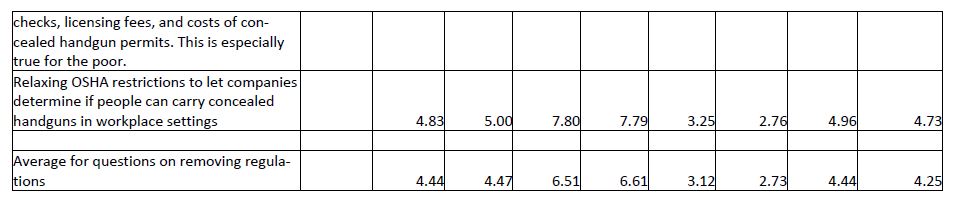
8. Relaxing OSHA restrictions to let companies determine if people can carry concealed
handguns in workplace settings
----------
Criminologists and economists differ somewhat in how strongly they feel that different policies
will work, but they rank policies similarly. Both have the same top four preferred policies for
stopping mass public shootings. American criminologists rate the following policies most highly:
allow K-12 teachers to carry concealed handguns (with a survey score of 6), allow military personnel
to carry on military bases (5.6), encourage the elimination of gun-free zones (5.3), and
relax OSHA regulations that pressure companies to create gun-free zones (5). The top four for
economists are the same, but in different order: encourage the elimination of gun-free zones
(7.9), relax OSHA regulations that pressure companies to create gun-free zones (7.8), allow K-12
teachers to carry concealed handguns (7.7), and allow military personnel to carry on military
bases (7.7).

By contrast, public health researchers place these same policies near the bottom of their list.
Their top policy choice of barring gun sales to people deemed dangerous by a mental health
provider is the fifth most valued policy by criminologists (4.88), but their other top policies
aren’t viewed positively by criminologists. Their second through fourth top-ranked policies are
banning magazines that can hold more than 10 bullets (6.2), banning semi-automatic guns (6.1),
and prohibiting assault weapon (5.98). All of these policies involve highly restrictive bans. For Criminologists, these were their 21st (2.6), 20th (2.8), and 10th (3) ranked policies. There was an
even larger gap between economists and public health researchers.

The patterns are similar when these different groups rate the effectiveness of policies at reducing
murder rates. While the proposal ranked most favorably by criminologists is reducing government-
imposed costs of acquiring guns (5.2), economists want to relax OSHA restrictions that
interfere with companies setting rules for people having guns (7.1) and public health people
want to prevent the sales of a firearm to people convicted of violent misdemeanors (7.3).
----------


Monday, September 02, 2019

The Climate Change Alarmists are missing solar forcing

Here is a link to a blog entry by Judith Curry, a renowned expert on climate.

She provides more evidence that the Climate Change Alarmists and much of the climate change scientific community are missing the importance of solar forcing on climate.

Here are some excerpts.
------------------------------------------
El Niño Southern Oscillation (ENSO) is the main source of interannual tropical climate variability with an important effect on global temperature and precipitation. Paleoclimatic evidence supports a relationship between ENSO and solar forcing. Moy et al. (2002) attribute the long-term increasing trend in ENSO frequency to orbitally induced changes in insolation (figure 1). The ENSO proxy record described by Moy et al. (2002) displays a millennial-scale oscillation that in the middle Holocene shifts its variance from a 1000-1500-yr period to a 2000-2500-yr period (Moy et al. 2002, their figure 1c). Both frequencies correspond to known solar periodicities, the Eddy and Bray solar cycles. As it has been shown previously (see “Centennial to millennial solar cycles“) the 1000-yr Eddy solar cycle became weaker at the Mid-Holocene Transition regaining strength in the last 2000 years. This 14C-deduced solar behavior corresponds to the ENSO behavior described by Moy et al. (2002).

In 2000 Theodore Landscheidt published an article in the proceedings from a meeting presenting his hypothesis of a solar forcing of El Niño and La Niña. He was not the first to defend such hypothesis, as 10 years earlier Roger Anderson (1990) had published some evidence for a solar cycle modulation of ENSO as a possible source of climatic change. Landscheidt’s (2000) article contains two observations and two predictions. The first observation is that most extreme ENSO events correlate with the ascending or descending phase of the solar cycle. He predicted the following El Niño based on the sun’s orbital angular momentum for 2002.9 (± 0.4). It was a 2-year ahead accurate prediction, as the next El Niño started in 2002.67. The second observation was the alternating preponderance of El Niño and La Niña following the 22-year Hale magnetic solar cycle. The 1954-76 Hale cycle showed Niña preponderance, and was followed by the 1976-96 that presented Niño dominance. While this is based only on two complete Hale cycles for which there is instrumental ENSO data it is interesting to read Landscheidt other prediction:

“If the pattern holds a preponderance of La Niña is to be expected during the Hale cycle that began in 1996.”
The Hale cycle-ENSO association is unclear to me due to insufficient data but it is undeniable that both of Landscheidt predictions were correct. Anderson’s and Landscheidt’s articles were completely ignored by the scientific community and they are rarely cited even by authors studying the same subject.

In 2008 van Loon & Meehl showed that the Pacific Ocean displayed a response to peak solar activity years similar to La Niña event years in the Southern Oscillation, but with a different stratospheric response. Haam & Tung (2012), however, failed to find an association between solar peak and La Niña years and warned that two autocorrelated time series might present a spurious correlation by chance. As I will show the problem is in the assumption that ENSO must display a linear response to solar activity with ENSO extremes at maximal and minimal solar activity. This assumption turns out to be false and the analysis of Haam & Tung (2012) using peak-solar years is misleading.

ENSO is usually described as a 2-7-year oscillation, while the Schwabe solar cycle is an 11 ± 2-year oscillation, so no linear relationship is obvious. White & Liu (2008) defend that most El Niño and La Niña episodes from 1900–2005 are grouped into non-commuting pairs that repeat every ~ 11 years, aligned with rising and falling transition phases of the solar cycle as Landscheidt (2000) described (they don’t cite him). These alignments arise from non-linear phase locking between an 11-year solar forced first harmonic and the 3rd and 5th 3.6 and 2.2-year harmonics in ENSO. These solar-forced 3rd and 5th harmonics explain ~ 52% of inter-annual variance in the Nino-3 temperature index. White & Liu (2008) propose “a new paradigm for ENSO, with El Niño and La Niña driven by the solar-forced quasi-decadal oscillation via non-linear processes in the tropical Pacific delayed action/recharge oscillator.”

Despite the evidence for a solar forcing of ENSO the accepted paradigm from model studies is that ENSO is self-excited or driven by internal variability random noise.

More recently two solar physicists, Leamon & McIntosh (2017), reported on the coincidence of the termination of the solar magnetic activity bands at the solar equator every ~ 11 years since the 1960s with a shift from El Niño to La Niña conditions in the Pacific. Their report prompted me to examine the issue, observing a pattern repetition since 1956 (figure 2). The solar minimum is preceded by Niña conditions, followed by Niño conditions, and afterwards Niña conditions accompany the rapid increase in solar activity.
If we assign 50% probability for seasonal positive or negative ONI (Oceanic Niño Index) values, the probability that the solar minimum will be preceded by Niña conditions, and followed by Niño conditions for six consecutive solar minima by chance is of only 0.024% (1 in 4000). The probability of the entire pattern (Niña-Niño-Niña) repeating six times at a specific time is even lower, indicating that the association between solar activity and ENSO is not due to chance. Solar control of ENSO has led to the prediction of El Niño conditions in 2018-19 by me, and to La Niña conditions in 2020-21 by Leamon & McIntosh (2017). The 2018-19 Niño prediction has been correct.
----------
Of course ENSO is not exclusively under solar control as it is a very complex phenomenon, and thus we shouldn’t expect that the patterns are always reproduced. However it is clear from paleoclimatic data (Moy et al., 2002), solar physics (Leamon & McIntosh 2017), Modeling and reanalysis (van Loon & Meehl 2008), frequency analysis (White & Liu 2008), and the present analysis, that solar activity has a clear strong effect on ENSO, probably being its main forcing. The reported 2-7-year ENSO periodicity appears to be an 11-year periodicity with several occurrences. The present (mid-2019) position in the solar cycle is at the transition between phases III-IV, close to the solar minimum. With some uncertainty due to the irregularity of the 11-yr solar cycle, a La Niña can be projected for phase V, by mid-2020 (Leamon & McIntosh 2017). The failed El Niño projection from February 2017 by ENSO models (figure 6) took place at the transition between phases II and III in figure 5, a time when the solar cycle favors La Niña conditions that finally developed a few months later. This is an instance when ENSO prediction from solar activity would have been superior to models.

Sunday, September 01, 2019

How the Media Help to Destroy Rational Climate Debate

Here is a blog entry from Roy Spencer, Ph.D.
-------------------------------------------
An old mantra of the news business is, “if it bleeds, it leads”. If someone was murdered, it is news. That virtually no one gets murdered is not news. That, by itself, should tell you that the mainstream media cannot be relied upon as an unbiased source of climate change information.

There are lots of self-proclaimed climate experts now. They don’t need a degree in physics or atmospheric science. For credentials, they only need to care and tell others they care. They believe the Earth is being murdered by humans and want the media to spread the word.

Most people do not have the time or educational background to understand the global warming debate, and so defer to the consensus of experts on the subject. The trouble is that no one ever says exactly what the experts agree upon.

When you dig into the details, what the experts agree upon in their official pronouncements is rather unremarkable. The Earth has warmed a little since the 1950s, a date chosen because before that humans had not produced enough CO2 to really matter. Not enough warming for most people to actually feel, but enough for thermometers to pick up the signal buried in the noise of natural weather swings of many tens of degrees and spurious warming from urbanization effects. The UN consensus is that most of that warming is probably due to increasing atmospheric CO2 from fossil fuel use (but we really don’t know for sure).

For now, I tend to agree with this consensus.

And still I am widely considered a climate denier.

Why? Because I am not willing to exaggerate and make claims that cannot be supported by data.

Take researcher Roger Pielke, Jr. as another example. Roger considers himself an environmentalist. He generally agrees with the predictions of the UN Intergovernmental Panel on Climate Change (IPCC) regarding future warming. But as an expert in severe weather damages, he isn’t willing to support the lie that severe weather has gotten worse. Yes, storm damages have increased, but that’s because we keep building more infrastructure to get damaged.

So, he, too is considered a climate denier.

What gets reported by the media about global warming (aka climate change, the climate crisis, and now the climate emergency) is usually greatly exaggerated, half-truths, or just plain nonsense. Just like the economy and economists, it is not difficult to find an expert willing to provide a prediction of gloom and doom. That makes interesting news. But it distorts the public perception of the dangers of climate change. And because it is reported as “science”, it is equated with truth.

In the case of climate change news, the predicted effects are almost universally biased toward Armageddon-like outcomes. Severe weather events that have always occurred (tornadoes, hurricanes, floods, droughts) are now reported with at least some blame placed on your SUV.

The major media outlets have so convinced themselves of the justness, righteousness, and truthfulness of their cause that they have banded together to make sure the climate emergency is not ignored. As reported by The Guardian, “More than 60 news outlets worldwide have signed on to Covering Climate Now, a project to improve coverage of the emergency”.

The exaggerations are not limited to just science. The reporting on engineering related to proposed alternative sources of energy (e.g. wind and solar) is also biased. The reported economics are biased. Unlimited “free” energy is claimed to be all around us, just waiting to be plucked from the unicorn tree.

And for most of America (and the world), the reporting is not making us smarter, but dumber.

Why does it matter? Who cares if the science (or engineering or economics) is exaggerated, if the result is that we stop polluting?

Besides the fact that there is no such thing as a non-polluting energy source, it matters because humanity depends upon abundant, affordable energy to prosper. Just Google life expectancy and per capita energy use. Prosperous societies are healthier and enjoy longer lives. Expensive sources of energy forced upon the masses by governmental fiat kill poor people simply because expensive energy exacerbates poverty, and poverty leads to premature death. As philosopher Alex Epstein writes in his book, The Moral Case for Fossil Fuels, if you believe humans have a right to thrive, then you should be supportive of fossil fuels.

We don’t use wind and solar energy because it is economically competitive. We use it because governments have decided to force taxpayers to pay the extra costs involved and allowed utilities to pass on the higher costs to consumers. Wind and solar use continue to grow, but global energy demand grows even faster. Barring some new energy technology (or a renewed embrace of nuclear power), wind and solar are unlikely to supply more than 10% of global energy demand in the coming decades. And as some European countries have learned, mandated use of solar and wind comes at a high cost to society.

Not only the media, but the public education system is complicit in this era of sloppy science reporting. I suppose most teachers and journalists believe what they are teaching and reporting on. But they still bear some responsibility for making sure what they report is relatively unbiased and factual.

I would much rather have teachers spending more time teaching students how to think and less time teaching them what to think.

Climate scientists are not without blame. They, like everyone else, are biased. Virtually all Earth scientists I know view the Earth as “fragile”. Their biases affect their analysis of uncertain data that can be interpreted in multiple ways. Most are relatively clueless about engineering and economics. I’ve had discussions with climate scientists who tell me, “Well, we need to get away from fossil fuels, anyway”.

And maybe we do, eventually. But exaggerating the threat can do more harm than good. The late Stephen Schneider infamously admitted to biased reporting by scientists. You can read his entire quote and decide for yourself whether scientists like Dr. Schneider let their worldview, politics, etc., color how they present their science to the public. The unauthorized release of the ‘ClimateGate’ emails between IPCC scientists showed how the alarmist narrative was maintained by undermining alternative views and even pressuring the editors of scientific journals. Even The Guardian seemed shocked by the misbehavior.

It’s fine to present the possibility that human-caused global warming could be very damaging, which is indeed theoretically possible. But to claim that large and damaging changes have already occurred due to increasing CO2 in the atmosphere is shoddy journalism. Some reporters get around the problem by saying that the latest hurricane might not be blamed on global warming directly, but it represents what we can expect more of in a warming world. Except that, even the UN IPCC is equivocal on the subject.

Sea level rise stories in the media, as far as I can tell, never mention that sea level has been rising naturally for as long as we have had global tide gauge measurements (since the 1850s). Maybe humans are responsible for a portion of the recent rise, but as is the case for essentially all climate reporting, the role of nature is seldom mentioned, and the size of the problem is almost always exaggerated. That worsening periodic tidal flooding in Miami Beach is about 50% due to sinking of reclaimed swampland is never mentioned.

There are no human fingerprints of global warming. None. Climate change is simply assumed to be mostly human-caused (which is indeed possible), while our knowledge of natural climate change is almost non-existent.

Computerized climate models are programmed based upon the assumption of human causation. The models produce human-caused climate change because they are forced to produce no warming (be in a state of ‘energy balance’) unless CO2 is added to them.

As far as we know, no one has ever been killed by human-caused climate change. Weather-related deaths have fallen dramatically — by over 90% — in the last 100 years.

Whose child has been taught that in school? What journalist has been brave enough to report that good news?

In recent years I’ve had more and more people tell me that their children, grandchildren, or young acquaintances are now thoroughly convinced we are destroying the planet with our carbon dioxide emissions from burning of fossil fuels. They’ve had this message drilled into their brains through news reporting, movies, their teachers and professors, their favorite celebrities, and a handful of outspoken scientists and politicians whose knowledge of the subject is a mile wide but only inches deep.

In contrast, few people are aware of the science papers showing satellite observations that reveal a global greening phenomenon is occurring as a result of more atmospheric CO2.

Again I ask, whose child has been taught this in school? What journalist dares to report any positive benefits of CO2, without which life on Earth would not exist?

No, if it’s climate news, it’s all bad news, all the time.

More Examples of Media Bias

Here are just a few recent (and not-so-recent) examples of media reporting which only make matters worse and degrade the public debate on the subject of climate change. Very often what is reported is actually weather-related events that have always occurred with no good evidence that they have worsened or become more frequent in the last 60+ years that humans could be at least partly blamed.

The Amazon is burning

A few days ago, The Guardian announced Large swathes of the Amazon rainforest are burning. I don’t know how this has suddenly entered the public’s consciousness, but for those of us who keep track of such things, farmland and some rainforest in Amazonia and adjacent lands has been burned by farmers for many decades during this time of year so they can plant crops. This year is not exceptional in this regard, yet someone decided to make an issue of it this year. In fact, it looks like 2019 might be one of the lowest years for biomass burning. Deforestation there has gone down dramatically in the last 20 years.

The rainforest itself does not burn in response to global warming, and in fact warming in the tropics has been so slow that it is unlikely that any tropical resident would perceive it in their lifetime. This is not a climate change issue; it’s a farming and land use issue.

Greenland Is rapidly melting

The Greenland ice sheet gains new snow every year, and gravity causes the sheet to slowly flow to the sea where ice is lost by calving of icebergs. How much ice resides in the sheet at any given time is based upon the balance between gains and losses.

During the summer months of June, July, and August there is more melting of the surface than snow accumulation. The recent (weather-related) episode of a Saharan air mass traveling through western Europe and reaching Greenland led to a few days of exceptional melt. This was widely reported as having grave consequences.

Forbes decided to push the limits of responsible journalism with a story title, Greenland’s Massive Ice Melt Wasn’t Supposed to Happen Until 2070. But the actual data show that after this very brief period (a few days) of strong melt, conditions then returned to normal.


The widely reported Greenland surface melt event around 1 August 2019 (green oval) was then followed by a recovery to normal in the following weeks (purple oval), which was not reported by the media.

Of course, only the brief period of melt was reported by the media, further feeding the steady diet of biased climate information we have all become accustomed to.

Furthermore, after all of the reports of record warmth at the summit of the ice cap, it was found that the temperature sensor readings were biased too warm, and the temperature never actually went above freezing.

Was this reported with the same fanfare as the original story? Of course not. The damage has been done, and the thousands of alarmist news stories will live on in perpetuity.

This isn’t to say that Greenland isn’t losing more ice than it is gaining, but most of that loss is due to calving of icebergs around the edge of the sheet being fed by ice flowing downhill. Not from blast-furnace heating of the surface. It could be the loss in recent decades is a delayed response to excess snow accumulation tens or hundreds of years ago (I took glaciology as a minor while working on my Ph.D. in meteorology). No one really knows because ice sheet dynamics is complicated with much uncertainty.

My point is that the public only hears about these brief weather events which are almost always used to promote an alarmist narrative.

July 2019 was the hottest month on record

The yearly, area-averaged surface temperature of the Earth is about 60 deg. F. It has been slowly and irregularly rising in recent decades at a rate of about 0.3 or 0.4 deg. F per decade.

So, let’s say the average temperature reaches 60.4 deg. F rather than a more normal 60 deg. F. Is “hottest” really the best adjective to use to inform the public about what is going on?

Here’s a geographic plot of the July 2019 departures from normal from NOAA’s Climate Forecast 
System model.

July 2019 surface temperature departures from normal. The global average is only 0.3 deg. C (0.5 deg. F) above the 1981-2010 average, and many areas were below normal in temperature. (Graphic courtesy WeatherBell.com).

Some areas were above normal, some below, yet the headlines of “hottest month ever” would make you think the whole Earth had become an oven of unbearable heat.

Of course, the temperature changes involved in new record warm months is so small it is usually less than the uncertainty level of the measurements. And, different global datasets give different results. Monitoring global warming is like searching for a climate needle in a haystack of weather variability.

Bait and Switch: Models replacing observations

There is an increasing trend toward passing off climate model projections as actual observations in news reports. This came up just a few days ago when I was alerted to a news story that claimed Tuscaloosa, Alabama is experiencing twice as many 100+ deg. F days as it used to. To his credit, the reporter corrected the story when it was pointed out to him that no such thing has happened, and it was a climate model projection that (erroneously) made such a “prediction”.

Another example happened last year with a news report that the 100th Meridian climate boundary in the U.S. was moving east, with gradual drying starting to invade the U.S. Midwest agricultural belt. But, once again, the truth is that no such thing has happened. It was a climate model projection, being passed off as reality. Having worked with grain-growing interests for nearly 10 years, I addressed this bit of fake climate news with actual precipitation measurements here.

Al Gore and Bill Nye’s global warming in a jar experiment

This is one of my favorites.

As part of Al Gore’s Climate Reality Project, Bill Nye produced a Climate 101 video of an experiment where two glass jars with thermometers in them were illuminated by lamps. One jar had air in it, the other had pure CO2. The video allegedly shows the jar with CO2 in it experiencing a larger temperature rise than the jar with just air in it.

Of course, this was meant to demonstrate how easy it is to show more CO2 causes warming. I’m sure it has inspired many school science experiments. The video has had over 500,000 views.

The problem is that this experiment cannot show such an effect. Any expert in atmospheric radiative transfer can tell you this. The jars are totally opaque to infrared radiation anyway, the amount of CO2 involved is far too small, the thermometers were cheap and inaccurate, the lamps cannot be exactly identical, the jars are not identical, and the “cold” of outer space was not included the experiment. TV meteorologist Anthony Watts demonstrated that Bill Nye had to fake the results through post-production video editing.

The warming effect of increasing atmospheric CO2 is surprisingly difficult to demonstrate. The demonstration is largely a theoretical exercise involving radiative absorption calculations and a radiative transfer model. I believe the effect exists; I’m just saying that there is no easy way to demonstrate it.

The trouble is that this fraudulent video still exists, and many thousands of people are being misled into believing that the experiment is evidence of how obvious it is to

Greta Thunberg’s sailboat trip

The new spokesperson for the world’s youth regarding concerns over global warming is 16-year-old Swede Greta Thunberg. Greta is travelling across the Atlantic on what CNN describes as a “zero-emissions yacht” to attend the UN Climate Action Summit on September 23 in New York City.

To begin with, there is no such thing as a zero-emissions yacht. A huge amount of energy was required to manufacture the yacht, and it transports so few people so few miles over its lifetime the yacht is a wonderful example of the energy waste typical of the lifestyles of the wealthy elite. Four (!) people will need to fly from Europe to the U.S. to support the return of the yacht to Europe after Greta is delivered there.

The trip is nothing more than a publicity stunt, and it leads to further disinformation regarding global energy use. In fact, it works much better as satire. Imagine if everyone who traveled across the ocean used yachts rather than jet airplanes. More energy would be required, not less, due to the manufacture of tens of thousands of extra yachts which inefficiently carry few passengers on relatively few, very slow trips. In contrast, the average jet aircraft will travel 50 million miles in its lifetime. Most people don’t realize that travel by jet is now more fuel efficient than travel by car.

The Greta boat trip story is in so many ways the absolute worst way to raise awareness of climate issues, unless you know knothing of science, engineering, or economics. It’s like someone who is against eating meat consuming three McDonalds cheeseburgers to show how we should change our diets. It makes zero sense.

I could give many more examples of the media helping to destroy the public’s ability to have a rational discussion about climate change, how much is caused by humans, and what can or should be done about it.

Instead, the media chooses to publish only the most headline-grabbing stories, and the climate change issue is then cast as two extremes: either you believe the “real scientists” who all agree we are destroying the planet, or you are a knuckle-dragging 8th-grade educated climate denier with guns and racist tendencies.

Sunday, August 25, 2019

More reason to question the extent of anthropogenic climate change

Here is a link to a paper by Kauppinen and Malmi, "No Experimental Evidence For The Significant Anthropogenic Climate Change".

The failure of Climate Alarmists to contemplate the impact of the sun on climate is a fatal flaw.  This conclusion is shared by some of the World's top scientists working on climate change, e.g., Nir Shaviv and Henrik Svensmark.

Here are some excerpts from the paper.
-----------------------------------------
Abstract.

In this paper we will prove that GCM-models used in IPCC report AR5 fail to calculate the influences of the low cloud cover changes on the global temperature. That is why those models give a very small natural temperature change leaving a very large change for the contribution of the green house gases in the observed temperature. This is the reason why IPCC has to use a very large sensitivity to compensate a too small natural component. Further they have to leave out the strong negative feedback due to the clouds in order to magnify the sensitivity. In addition, this paper proves that the changes in the low cloud cover fraction practically control the global temperature.

The climate sensitivity has an extremely large uncertainty in the scientific literature. The smallest values estimated are very close to zero while the highest ones are even 9 degrees Celsius for a doubling of CO2. The majority of the papers are using theoretical general circulation models (GCM) for the estimation. These models give very big sensitivities with a very large uncertainty range. Typically sensitivity values are between 2–5 degrees. IPCC uses these papers to estimate the global temperature anomalies and the climate sensitivity. However, there are a lot of papers, where sensitivities lower than one degree are estimated without using GCM. The basic problem is still a missing experimental evidence of the climate sensitivity. One of the authors (JK) worked as an expert reviewer of IPCC AR5 report. One of his comments concerned the missing experimental evidence for the very large sensitivity presented in the report [1]. As a response to the comment IPCC claims that an observational evidence exists for example in Technical Summary of the report. In this paper we will study the case carefully.

2. Low cloud cover controls practically the global temperature

The basic task is to divide the observed global temperature anomaly into two parts: the natural component and the part due to the green house gases. In order to study the response we have to re-present Figure TS.12 from Technical Summary of IPCC AR5 report (1). This figure is Figure 1. Here we highlight the subfigure “Land and ocean surface” in Figure 1. Only the black curve is an observed temperature anomaly in that figure. The red and blue envelopes are computed using climate models. We do not consider computational results as experimental evidence. Especially the results obtained by climate models are questionable because the results are conflicting with each other.

In Figure 2 we see the observed global temperature anomaly (red) and global low cloud cover changes (blue). These experimental observations indicate that 1 % increase of the low cloud cover fraction decreases the temperature by 0.11°C. This number is in very good agreement with the theory given in the papers [3, 2, 4]. Using this result we are able to present the natural temperature anomaly by multiplying the changes of the low cloud cover by −0.11°C/%. This natural contribution (blue) is shown in Figure 3 superimposed on the observed temperature anomaly (red). As we can see there is no room for the contribution of greenhouse gases i.e. anthropogenic forcing within this experimental accuracy. Even though the monthly temperature anomaly is very noisy it is easy to notice a couple of decreasing periods in the increasing trend of the temperature. This behavior cannot be explained by the monotonically increasing concentration of CO2 and it seems to be far beyond the accuracy of the climate models.

The red curve in Figures 2 and 3 corresponds to the black curve, between years 1983 and 2008, in the above-mentioned subfigure “Land and ocean surface”. If the clouds and CO2 were taken into account correctly in the climate models both the blue and red envelopes should overlap the observed black curve. As we see the trend of the blue envelope is more like decreasing. We suggest this is due to a wrong or missing processing of the low cloud cover contribution. In the report AR5 it is even recognized that the low clouds give the largest uncertainty in computation. In spite of this IPCC still assumes that the difference between the blue and red envelopes in Figure 1 is the contribution of greenhouse gases. Unfortunately, the time interval (1983–2008) in Fig 2 is limited to 25 years because of the lack of the low cloud cover data. During this time period the CO2 concentration increased from 343 ppm to 386 ppm and both Figures 1 (IPCC) and 2 show the observed temperature increase of about 0.4°C. The actual global temperature change, when the concentration of CO2 raises from C0 to C, is

∆T =∆T2CO2 lnC/C0 ln2 −11°C·∆c,          (1)

where ∆T2CO2 is the global temperature change, when the CO2 concentration is doubled and ∆c is the change of the low cloud cover fraction. The first and second term are the contributions of CO2 [5] and the low clouds, respectively. Using the sensitivity ∆T2CO2 = 0.24°C derived in the papers [3, 2, 4] the contribution of greenhouse gases to the temperature is only about 0.04°C according to the first term in the above equation. This is the reason why we do not see this small increase in temperature in Figure 3, where the temperature anomaly is quite noisy with one month time resolution. It is clearly seen in Figure 2 that the red and blue anomalies are like mirror images. This means that the first term is much smaller than the absolute value of the second term (11°C·∆c) in equation (1).

It turns out that the changes in the relative humidity and in the low cloud cover depend on each other [4]. So, instead of low cloud cover we can use the changes of the relative humidity in order to derive the natural temperature anomaly. According to the observations 1 % increase of the relative humidity decreases the temperature by 0.15°C, and consequently the last term in the above equation can be approximated by −15°C∆φ, where ∆φ is the change of the relative humidity at the altitude of the low clouds.

Figure 4 shows the sum of the temperature changes due to the natural and CO2 contributions compared with the observed temperature anomaly. The natural component has been calculated using the changes of the relative humidity. Now we see that the natural forcing does not explain fully the observed temperature anomaly. So we have to add the contribution of CO2 (green line), because the timeinterval is now 40 years (1970–2010). The concentration of CO2 has now increased from 326 ppm to 389 ppm. The green line has been calculated using the sensitivity 0.24°C, which seems to be correct. In Fig. 4 we see clearly how well a change in the relative humidity can model the strong temperature minimum around the year 1975. This is impossible to interpret by CO2 concentration. 

The IPCC climate sensitivity is about one order of magnitude too high, because a strong negative feedback of the clouds is missing in climate models. If we pay attention to the fact that only a small part of the increased CO2 concentration is anthropogenic, we have to recognize that the anthropogenic climate change does not exist in practice. The major part of the extra CO2 is emitted from oceans [6], according to Henry‘s law. The low clouds practically control the global average temperature. During the last hundred years the temperature is increased about 0.1°C because of CO2. The human contribution was about 0.01°C.

3. Conclusion
We have proven that the GCM-models used in IPCC report AR5 cannot compute correctly the natural component included in the observed global temperature. The reason is that the models fail to derive the influences of low cloud cover fraction on the global temperature. A too small natural component results in a too large portion for the contribution of the greenhouse gases like carbon dioxide. That is why IPCC represents the climate sensitivity more than one order of magnitude larger than our sensitivity 0.24°C. Because the anthropogenic portion in the increased CO2 is less than 10 %, we have practically no anthropogenic climate change. The low clouds control mainly the global temperature.

Friday, August 23, 2019

Climate Change: What's the Worst Case?

Here is a blog entry from Judith Curry's blog.  JC is a recognized expert in the field.

JC is on target.

The message: The Alarmists are "Alarmists".  The climate change stories you usually hear about are not credible.

My prediction is that within ten years, the current "scientific consensus" you hear about will be proven to be a combination of bad physics and bad statistics.

JC's comments at the end of the  blog entry about the "peer" reactions she has experienced are telling.  Alarmist bias among climate change "scientists" is rampant.
-------------------------------------------
My new manuscript is now available.

A link to my new paper ‘Climate Change: What’s the Worst Case?’ is provided here [worst case paper final (1)]

A few words on the intended audience and motivation for writing this:

First and foremost, this is written for the clients of Climate Forecast Applications Network who are interested in scenarios of future climate change [link]

Second, this paper is written as a contribution to my series of academic papers on the topic of uncertainty in climate science:
Climate Science and the Uncertainty Monster
Reasoning About Climate Uncertainty
Nullifying the Climate Null Hypothesis
Climate Change: No Consensus on Consensus
Climate Uncertainty and Risk

Third, the paper is written to inform the public debate on climate change and policy makers. I am ever hopeful that some sanity can be interjected into all this.

This paper is particularly relevant in light on the preceding post on consensus, and Gavin’s desire for a better way to treat the extreme tails.

Overview of contents

I’m reproducing the Abstract, Introduction and Conclusions in this blog post, I encourage you to read the entire paper.

Abstract. The objective of this paper is to provide a broader framing for how we assess and reason about possible worst-case outcomes for 21st century climate change. A possibilistic approach is proposed as a framework for summarizing our knowledge about projections of 21st century climate outcomes. Different methods for generating and justifying scenarios of future outcomes are described. Consideration of atmospheric emissions/concentration scenarios, equilibrium climate sensitivity, and sea-level rise projections illustrate different types of constraints and uncertainties in assessing worst-case outcomes. A rationale is provided for distinguishing between the conceivable worst case, the possible worst case and the plausible worst case, each of which plays different roles in scientific research versus risk management.

1.Introduction

The concern over climate change is not so much about the warming that has occurred over the past century. Rather, the concern is about projections of 21st century climate change based on climate model simulations of human-caused global warming, particularly those driven by the RCP8.5 greenhouse gas concentration scenario.

The Intergovernmental Panel on Climate Change (IPCC) Assessment Reports have focused on assessing a likely range (>66% probability) for projections in response to different emissions concentration pathways. Oppenheimer et al. (2007) contends that the emphasis on consensus in IPCC reports has been on expected outcomes, which then become anchored via numerical estimates in the minds of policy makers. Thus, the tails of the distribution of climate impacts, where experts may disagree on likelihood or where understanding is limited, are often understated in the assessment process, and then exaggerated in public discourse on climate change.

In an influential paper, Weitzman (2009) argued that climate policy should be directed at reducing the risks of worst-case outcomes, not at balancing the most likely values of costs and benefits. Ackerman (2017) has argued that policy should be based on the credible worst-case outcome. Worst-case scenarios of 21st century sea level rise are becoming anchored as outcomes that are driving local adaptation plans (e.g. Katsman et al. 2011). Projections of future extreme weather/climate events driven by the worst-case RCP8.5 scenario are highly influential in the public discourse on climate change (e.g. Wallace-Wells, 2019).

The risk management literature has discussed the need for a broad range of scenarios of future climate outcomes (e.g., Trutnevyte et al. 2016). Reporting the full range of plausible and possible outcomes, even if unlikely, controversial or poorly understood, is essential for scientific assessments for policy making. The challenge is to articulate an appropriately broad range of future scenarios, including worst-case scenarios, while rejecting impossible scenarios.

How to rationally make judgments about the plausibility of extreme scenarios and outcomes remains a topic that has received too little attention. Are all of the ‘worst-case’ climate outcomes described in assessment reports, journal publications and the media, actually plausible? Are some of these outcomes impossible? On the other hand, are there unexplored worst-case scenarios that we have missed, that could turn out to be real outcomes? Are there too many unknowns for us to have confidence that we have credibly identified the worst case? What threshold of plausibility or credibility should be used when assessing these extreme scenarios for policy making and risk management?

This paper explores these questions by integrating climate science with perspectives from the philosophy of science and risk management. The objective is to provide a broader framing of the 21st century climate change problem in context of how we assess and reason about worst-case climate outcomes. A possibilistic framework is articulated for organizing our knowledge about 21st century projections, including how we extend partial positions in identifying plausible worst-case scenarios of 21st climate change. Consideration of atmospheric emissions/concentration scenarios, equilibrium climate sensitivity, and sea-level rise illustrate different types of constraints and uncertainties in assessing worst-case outcomes. This approach provides a rationale for distinguishing between the conceivable worst case, the possible worst case and the plausible worst case, each of which plays different roles in scientific research versus risk management.

2. Possibilistic framework

3. Scenarios of future outcomes

3.1 Scenario justification

3.2 Worst-case classification

3.3 Alternative scenarios

4. Is RCP8.5 plausible?

5. Climate sensitivity

6. Sea level rise

6.1 Worst-case scenarios

6.2 Possibility distribution

6.3 Alternative scenarios

7. Conclusions

The purpose of generating scenarios of future outcomes is that we should not be too surprised when the future eventually arrives. Projections of 21st century climate change and sea level rise are associated with deep uncertainty and rapidly advancing knowledge frontiers. The objective of this paper has been to articulate a strategy for portraying scientific understanding of the full range of possible scenarios of 21st century climate change and sea level rise in context of a rapidly expanding knowledge base, with a focus on worst-case scenarios.

A classification of future scenarios is presented, based on relative immunity to rejection relative to our current background knowledge and assessments of the knowledge frontier. The logic of partial positions allows for clarifying what we actually know with confidence, versus what is more speculative and uncertain or impossible. To avoid the Alice in Wonderland syndrome of scenarios that include too many implausible assumptions, published worst-case scenarios are assessed using the plausibility criterion of including only one borderline implausible assumption (where experts disagree on plausibility).

The possibilistic framework presented here provides a more nuanced way for articulating our foreknowledge than either by attempting, on the one hand, to construct probabilities of future outcomes, or on the other hand simply by labeling some statements about the future as possible. The possibilistic classification also avoids ignoring scenarios or classifying them as extremely unlikely if they are driven by processes that are poorly understood or not easily quantified.

The concepts of the possibility distribution, worst-case scenarios and partial positions are relevant to decision making under deep uncertainty (e.g. Walker et al. 2016), where precautionary and robust approaches are appropriate. Consideration of worst-case scenarios is an essential feature of precaution. A robust policy is defined as yielding outcomes that are deemed to be satisfactory across a wide range of plausible future outcomes. Robust policy making interfaces well with possibilistic approaches that generate a range of possible futures (e.g. Lempert et al. 2012). Partial positions are of relevance to flexible defense measures in the face of deep uncertainty in future projections (e.g. Oppenheimer and Alley, 2017).

Returning to Ackerman’s (2017) argument that policy should be based on the credible worst-case outcome, the issue then becomes how to judge what is ‘credible.’ It has been argued here that a useful criterion for a plausible (credible) worst-case climate outcome is that at most one borderline implausible assumption – defined as an assumption where experts disagree as to whether or not it is plausible – is included in developing the scenario. Using this criterion, the following summarizes my assessment of the plausible (credible) worst-case climate outcomes, based upon our current background knowledge: 
  • The largest rates of warming that are often cited in impact assessment analyses (e.g. 4.5 or 5 oC) rely on climate models being driven by a borderline implausible concentration/emission scenarios (RCP8.5). 
  • The IPCC AR5 (2013) likely range of warming at the end of the 21st century has a top-range value of 3.1 oC, if the RCP8.5-derived values are eliminated. Even the more moderate amount of warming of 3.1oC relies on climate models with values of the equilibrium climate sensitivity that are larger than can be defended based on analysis of historical climate change. Further, these rates of warming explicitly assume that the climate of the 21st century will be driven solely by anthropogenic changes to the atmospheric concentration, neglecting 21st century variations in the sun and solar indirect effects, volcanic eruptions, and multi-decadal to millennial scale ocean oscillations. Natural processes have the potential to counteract or amplify the impacts of any manmade warming. 
  • Estimates of 21st century sea level rise exceeding 1 m require at least one borderline implausible or very weakly justified assumption. Allowing for one borderline implausible assumption in the sea level rise projection produces high-end estimates of sea level rise of 1.1 to 1.6 m. Higher estimates are produced using multiple borderline implausible or very weakly justified assumptions. The most extreme of the published worst-case scenarios require a cascade of events, each of which are extremely unlikely to borderline impossible based on our current knowledge base. However, given the substantial uncertainties and unknowns surrounding ice sheet dynamics, these scenarios should not be rejected as impossible.
The approach presented here is very different from the practice of the IPCC assessments and their focus on determining a likely range driven by human-caused warming. In climate science there has been a tension between the drive towards consensus to support policy making versus exploratory speculation and research that pushes forward the knowledge frontier (e.g. Curry and Webster, 2013). The possibility analysis presented here integrates both approaches by providing a useful framework for integrating expert speculation and model simulations with more firmly established theory and observations. This approach demonstrates a way of stratifying the current knowledge base that is consistent with deep uncertainty, disagreement among experts and a rapidly evolving knowledge base. Consideration of a more extensive range of future scenarios of climate outcomes can stimulate climate research as well as provide a better foundation for robust decision making under conditions of deep uncertainty.

Publication status

Since I resigned my faculty position, there has been little motivation for me to publish in peer reviewed journals. And I don’t miss the little ‘games’ of the peer review process, not to mention the hostility and nastiness of editors and reviewers who have an agenda.

However, one of my clients wants me to publish more journal articles. This client particularly encouraged me to publish something related to my Special Report on Sea Level and Climate Change. I submitted a shorter version of this paper, in a more academic style, for publication in a climate journal. It was rejected. Here is my ‘favorite’ comment from one of the reviewers:

“Overall, there is the danger that the paper is used by unscrupulous people to create confusion or to discredit climate or sea-level science. Hence, I suggest that the author reconsiders the essence of its contribution to the scientific debate on climate and sea-level science.”

You get the picture. I can certainly get some version of this published somewhere, but this review reminded me why I shouldn’t bother with official ‘peer review.’ Publishing my research on Climate Etc. and as Reports ‘published’ by my company allows me to write my papers in a longer format, including as many references as I want. I can also ‘editorialize’ as I deem appropriate. In summary, I can write what I want, without worrying about the norms and agendas of the ‘establishment.’ Most of my readers want to read MY judgments, rather than something I think I can get past ‘peer reviewers.’

This particular paper is titled as a ‘Working Paper’, in the tradition often used by economists and legal scholars in issuing their reports. It is publicly available for discussion, and I can revise it when appropriate. I hope it will stimulate people to actually think about these issues and discuss them. I look forward to a lively review of this paper.

And finally, it is difficult to see how this paper could be categorized at ‘contrarian.’ It is not even ‘lukewarm.’ It discusses worst-case scenarios, and how to think about their plausibility. In fact, in one of the threads at WUWT discussing one of my previous ‘worst-case’ posts, commenters thought that this was way too ‘alarmist’ to be posted at WUWT.

Bottom line: we need to think harder and differently about climate change. This paper helps provide a framework for stepping beyond the little box that we are currently caught in.

Thursday, August 22, 2019

A further decline in our freedom

Here is Judge Andrew Napolitano "More Spying and Lying"

JAN is on target.

We are no longer a free country and it is getting less free.
----------------------------------------------------
While most of us have been thinking about the end of summer and while the political class frets over the Democratic presidential debates and the aborted visit of two members of Congress to Israel, the Trump administration has quietly moved to extend and make permanent the government's authority to spy on all persons in America.

The president, never at a loss for words, must have been asked by the intelligence community he once reviled not to address these matters in public.

These matters include the very means and the very secret court about which he complained loud and long during the Mueller investigation. Now, he wants to be able to unleash permanently on all of us the evils he claims were visited upon him by the Obama-era FBI and by his own FBI. What's going on?

Here is the backstory.

After the lawlessness of Watergate had been exposed — a president spying on his political adversaries without warrants in the name of national security — Congress enacted in 1978 the Foreign Intelligence Surveillance Act. It prescribed a means for surveillance other than that which the Constitution requires.

The Fourth Amendment to the Constitution — written in the aftermath of British soldiers and agents using general warrants obtained from a secret court in London to spy on whomever in the colonies they wished and to seize whatever they found — was ratified as part of the Bill of Rights to limit the government's ability to intrude upon the privacy of all persons, thereby prohibiting those procedures used by the British.

Thus, we have the constitutional requirements that no searches and seizures can occur without a warrant issued by a judge based on a showing, under oath, of probable cause of crime. The courts have uniformly characterized electronic surveillance as a search.

I am not addressing eyesight surveillance on a public street. I am addressing electronic surveillance wherever one is when one sends or receives digital communications. FISA is an unconstitutional congressional effort to lower the standards required by the Fourth Amendment from probable cause of crime to probable cause of foreign agency.

Can Congress do that? Can it change a provision of the Constitution? Of course not. If it could, we wouldn't have a Constitution.

It gets worse.

The court established by FISA — that's the same court that President Donald Trump asserts authorized spying on him in 2015 and 2016 — has morphed the requirement of probable cause of being a foreign agent to probable cause of communicating with a foreign person as the standard for authorizing surveillance.

What was initially aimed at foreign agents physically present in the United States has secretly become a means to spy on innocent Americans. In Trump's case, the FISA court used the foreign and irrelevant communications of two part-time campaign workers to justify surveillance on the campaign.

Add to all this the 2002 secret order of President George W. Bush directing the National Security Agency to spy on all in America all the time without warrants — this is what Edward Snowden exposed in 2013 — and one can see what has happened.

What happened?

What happened was the creation of a surveillance state in America that came about by secret court rulings and a once-secret presidential order. As a result of this, part of the government goes to the secret FISA court and obtains search warrants on flimsy and unconstitutional grounds and part of the government bypasses FISA altogether and spies on everyone in America and denies it and lies about it.

Bill Binney, the genius mathematician who once worked for the NSA and now is its harshest critic, has stated many times that, as unconstitutional as FISA is, it is a pretext to NSA spying on all persons in America all the time.

How pervasive is this unlawful spying? According to Binney, the NSA's 60,000 domestic spies capture the content and the keystrokes of every communication transmitted on fiber optic cables into or out of or wholly within the United States. And they do so 24/7 — without warrants.

Now, back to that quiet late summer proposal by the Trump administration. Some of the statutes that govern who can go to the FISA court and under what circumstances they can go are about to expire. Inexplicably, the president once victimized by FISA wants to make these statutes permanent. And he wants to do so knowing that they are essentially a facade for spying. That would institutionalize the now decades-long federal assault on privacy and evasion of constitutional norms.

It would also place Trump in the same category as his two immediate predecessors, who regularly ordered government agents to violate the Fourth Amendment and then denied they had done so.

Some of my Fox colleagues joke with me that I am shoveling against the tide when it comes to defending the right to privacy. They claim that there is no more privacy. I disagree with them. As long as we still have a Constitution, it must be taken seriously and must mean what it says. And its intentionally stringent requirements for enabling the government to invade privacy remain the law of the land. The president has sworn to uphold the Constitution, not the NSA.

The late Supreme Court Justice George Sutherland once wrote that we cannot pick and choose which parts of the Constitution to follow and which to ignore. If we could, the Constitution would be meaningless.

Did he foresee our present woes when he wrote, "If the provisions of the Constitution be not upheld when they pinch as well as when they comfort, they may as well be abandoned"?

Is that where we are headed?

Saturday, August 17, 2019

Climate and cosmic rays

Here is a very interesting partly biographical article by Nir Shaviv titled "How Might Climate be Influenced by Cosmic Rays".

This influence has been virtually totally ignored by the vast majority of climate scientists - no wonder the climate models quoted so often don't work well.

Nir Shaviv, IBM Einstein Fellow and Member in the School of Natural Sciences, is focusing on cosmic ray diffusion in the dynamic galaxy, the solar cosmic ray–­climate link, and the appearance of extremely luminous (super-Eddington) states in stellar evolution during his stay at the Institute of Advanced Study at Princeton. Shaviv is Professor at the Racah Institute of Physics at the Hebrew University of Jerusalem.
---------------------------------------------------
In 1913, Victor Hess measured the background level of atmospheric ionization while ascending with a balloon. By doing so, he discovered that Earth is continuously bathed in ionizing radiation. These cosmic rays primarily consist of protons and heavier nuclei with energies between their rest mass and a trillion times larger. In 1934, Walter Baade and Fritz Zwicky suggested that cosmic rays originate from supernovae, the explosive death of massive stars. However, only in 2013 was it directly proved, using gamma-ray observations with the FERMI satellite, that cosmic rays are indeed accelerated by supernova remnants. Thus, the amount of ionization in the lower atmosphere is almost entirely governed by supernova explosions that took place in the solar system’s galactic neighborhood in the past twenty million years or so.

Besides being messengers from ancient explosions, cosmic rays are extremely interesting because they link together so many different phenomena. They tell us about the galactic geography, about the history of meteorites or of solar activity, they can potentially tell us about the existence of dark matter, and apparently they can even affect climate here on Earth. They can explain many of the past climate variations, which in turn can be used to study the Milky Way.

The idea that cosmic rays may affect climate through modulation of the cosmic ray ionization in the atmosphere goes back to Edward Ney in 1959. It was known that solar wind modulates the flux of cosmic rays reaching Earth—a high solar activity deflects more of the cosmic rays reaching the inner solar system, and with it reduces the atmospheric ionization. Ney raised the idea that this ionization could have some climatic effect. This would immediately link solar activity with climate variations, and explain things like the little ice age during the Maunder minimum, when sunspots were a rare occurrence on the solar surface.

In the 1990s, Henrik Svensmark from Copenhagen brought the first empirical evidence of this link in the form of a correlation between cloud cover and the cosmic ray flux variations over the solar cycle. This link was later supported with further evidence including climate correlations with cosmic ray flux variations that are independent of solar activity, as I describe below, and, more recently, with laboratory experiments showing how ions play a role in the nucleation of small aerosols and their growth to larger ones.

In 2000, I was asked by a German colleague about possible effects that supernovae could have on life on Earth. After researching a bit, I stumbled on Svensmark’s results and realized that the solar system’s galactic environment should be changing on time scales of tens of millions of years. If cosmic rays affect the terrestrial climate, we should see a clear signature of the galactic spiral arm passages in the paleoclimatic data, through which we pass every 150 million years. This is because spiral arms are the regions where most supernovae take place in our galaxy. Little did I know, it would take me on a still ongoing field trip to the Milky Way.

The main evidence linking the galactic environment and climate on Earth is the exposure ages of iron meteorites. Exposure ages of meteorites are the inferred duration between their breakup from their parent bodies and their penetration into Earth’s atmosphere. They are obtained by measuring the radioactive and stable isotopes accumulated through interaction with the cosmic rays perfusing the solar system. It turns out that if one looks at exposure ages a bit differently than previously done, by assuming that meteorites form at a statistically constant rate while the cosmic ray flux can vary, as opposed to the opposite, then the cosmic ray flux history can be reconstructed. It exhibits seven clear cycles, which coincide with the seven periods of ice-age epochs that took place over the past billion years. On longer time scales, it is possible to reconstruct the overall cosmic ray flux variations from a changed star formation rate in the Milky Way, though less reliably. The variable star formation rate can explain why ice-age epochs existed over the past billion years and between one and two billion years ago, but not in other eons.

I later joined forces with Canadian geochemist Ján Veizer who had the best geochemical reconstruction of the temperature over the past half billion years, during which multicellular life left fossils for his group to dig and measure. His original goal was to fingerprint the role of CO2 over geological time scales, but no correlation with the paleotemperature was apparent. On the other hand, his temperature reconstruction fit the cosmic ray reconstruction like a glove. When we published these results, we instantly became personae non gratae in certain communities, not because we offered a data-supported explanation to the long-term climate variations, but because we dared say that CO2 can at most have a modest effect on the global temperature.

Besides the spiral arm passages, our galactic motion should give rise to a faster cosmic ray flux modulation—in addition to the solar system’s orbit around the galaxy, with roughly a 250-million-year period, the solar system also oscillates perpendicular to the galactic plane. Since the cosmic ray density is higher at the plane, it should be colder every time the solar system crosses it, which depending on the exact amount of mass in the disk should be every 30 to 40 million years.

A decade ago, the geochemical climate record showed hints of a 32-million-year periodicity, with peak cooling taking place a few million years ago, as expected from the last plane passage. Together with Veizer and a third colleague, Andreas Prokoph, we then submitted a first version for publication. However, we actually ended up putting the paper aside for almost a decade because of two nagging inconsistencies.

First, analysis of the best database of the kinematics of nearby stars, that of the Hipparcos satellite, pointed to a low density at the galactic plane, which in turn implied a longer period for the plane crossings, around once every 40 million years. Second, it was widely accepted in the cosmic ray community that cosmic rays should be diffusing around the galactic disk in a halo that is much larger than the stellar disk itself. This would imply that the 300 light years that the solar system ventures away from the galactic plane could not explain the 1 to 2°C variations implied for the geochemical record. Without a way to reconcile these, there was not much we could do. Perhaps the 32 million years was just a random artifact.

As time progressed, however, the improved geochemical record only showed that the 32-million-year signal became more prominent. In fact, fifteen cycles could now be clearly seen in the data. But something else also happened. My colleagues and I began to systematically study cosmic ray diffusion in the Milky Way while alleviating the standard assumption that everyone had until then assumed—that the sources are distributed symmetrically around the galaxy. To our surprise, it did much more than just explain the meteoritic measurements of a variable cosmic ray flux. It provided an explanation to the so-called Pamela anomaly, a cosmic ray positron excess that was argued by many to be the telltale signature of dark matter decay. It also explained the behavior of secondary cosmic rays produced along the way. But in order for the results to be consistent with the range of observations, the cosmic ray diffusion model had to include a smaller halo, one that more closely resembles the disk. In such a halo, the vertical oscillation of the solar system should have left an imprint in the geochemical record not unlike the one detected.

Thus, armed with the smaller halo and a more prominent paleoclimate signal, we decided to clear the dust off the old paper. The first surprise came when studying the up-to-date data. It revealed that the 32-million-year signal also has a secondary frequency modulation, that is, it is periodically either slower or longer. This modulation has a period and phase corresponding to the radial oscillations that the solar system exhibits while revolving around the galaxy. When it is closer to the galactic center, the higher density at the galactic plane forces it to oscillate faster, while when far from the center, the density is lower and the oscillation period is longer.

The second surprise came when studying the stellar kinematics from the astrometric data. We found that the previous analysis, which appeared to have been inconsistent, relied on the assumption that the stars are more kinematically relaxed then they are. As a consequence, there was a large unaccounted systematic error—without it there was no real inconsistency. It took almost a decade, but things finally fell into place.

The results have two particularly interesting implications. First, they bring yet another link between the galactic environment and the terrestrial climate. Although there is no direct evidence that cosmic rays are the actual link on the 32-million-year time scale, as far as we know, they are the only link that can explain these observations. This in turn strengthens the idea that cosmic ray variations through solar activity affect the climate. In this picture, solar activity increase is responsible for about half of the twentieth-century global warming through a reduction of the cosmic ray flux, leaving less to be explained by anthropogenic activity. Also, in this picture, climate sensitivity is on the low side (perhaps 1 to 1.5°C increase per CO2 doubling, compared with the 1.5 to 4.5°C range advocated by the IPCC), implying that the future is not as dire as often prophesied.

The second interesting implication is the actual value of the 32-million-year oscillation. The relatively short period indicates that there is more mass in the galactic plane than accounted for in stars and interstellar gas, leaving the remainder as dark matter. However, this amount of dark matter is more than would be expected if it were distributed sparsely in a puffed-up halo as is generally expected. In other words, this excess mass requires at least some of the dark matter to condense into the disk. If correct, it will close a circle that started in the 1960s when Edward Hill and Jan Oort suggested, based on kinematic evidence, that there is more matter at the plane than observed. This inconsistency and indirect evidence for dark matter was also advocated by John Bahcall, who for many years was a Faculty member here at the IAS.

It should be noted that the idea that cosmic rays affect the climate is by no means generally accepted. The link is contentious and it has attracted significant opponents over the years because of its ramifications to our understanding of recent and future climate change. For it to be finally accepted, one has to understand all the microphysics and chemistry associated with it. For this reason, we are now carrying out a lab experiment to pinpoint the mechanism responsible for linking atmospheric ions and cloud condensation nuclei. This should solidify a complete theory to explain the empirical evidence.

As for the existence of more dark matter in the galactic plane than naively expected, we will not have to wait long for it to be corroborated (or refuted). The GAIA astrometric satellite mapping the kinematics of stars to unprecedented accuracy will allow for a much better measurement of the density at the plane. The first release of data is expected to be in 2016, just around the corner.