Thursday, November 09, 2017

Does 2+2=1 sound right?

Here is a quote from an article in The Guardian - a British publication.

The three richest people in the US – Bill Gates, Jeff Bezos and Warren Buffett – own as much wealth as the bottom half of the US population, or 160 million people. 

Analysis of the wealth of America’s richest people found that Gates, Bezos and Buffett were sitting on a combined $248.5bn (£190bn) fortune. The Institute for Policy Studies said the growing gap between rich and poor had created a “moral crisis”.


What are we to make of this?  Is it credible?

Let's see - Divide $248.5 billion by 160 million - you get $1,550.  Is it credible that the average wealth of the poorest 160 million US citizens is only $1,550?  No.  What does this imply?  That neither the Guardian nor the Institute for Policy Studies is credible.

Wednesday, November 08, 2017

An example of the dishonesty of some anti-gun academics

Here is a rejoinder by Carlisle Moody, John Lott, and Thomas Marvell to an American Law and Economics Review article by Abhay Aneja, John Donohue, and Alexandria Zhang criticizing - and even slandering Lott.

This kind of dishonest and/or incompetent research by Lott's academic critics is common.  Donohue, in particular, has written (alone and with co-authors) several academic papers criticizing Lott's work showing that allowing honest citizens to carry concealed firearms reduces the violent crime rate, including murders.  Yet, despite being shown the flaws in his research that invalidate his claims, Donohue and his co-authors have continued their unethical behavior of misrepresenting Lott's work.

Here is the rejoinder.
-----------------------------------------
In an American Law and Economics Review article published during 2011, Abhay Aneja, John Donohue III, and Alexandria Zhang (hereafter ADZ) examined Chapter 6 of Firearms and violence: ACriticalReview, a 2005 report from the National Research Council (hereafter NRC). The chapter examined by ADZ is concerned with the effect that right-to-carry laws have on crime. The laws are also known as shall-issue laws, and we employ that term. Shall-issue laws require authorities to issue concealed carry permits to all persons who meet certain legislated requirements. Aside from Illinois, states that have not passed shall-issue laws leave it up to the issuing authorities, typically local police or sheriff departments, to determine whether or not to grant the applicant a concealed weapons permit.Such states are known as “may-issue” states.It is usually the case that may-issue states, especially in urban cities and counties, issue very few concealed carry permits, and most of these go to celebrities, wealthy individuals, and politicians (Snyder 1997). An interesting policy question is whether shall-issue laws, which increase the number of concealed carry permits, increase or decrease crime. One theory is that criminals, knowing that some ordinary citizens may be carrying firearms and, being unable to tell those who are from those who aren’t, will be more likely to forego a violent crime for fear of being met with armed resistance. Under this theory, violent crime should go down as a result of the passage of shall-issue laws.

The original article in this area is by John Lott and David Mustard (1997), who found that states with shall-issue laws had significantly lower violent crime rates than may-issue states or states that ban concealed carry. The publication of Lott and Mustard’s article generated a controversy that continues to this day. The Lott and Mustard results have been tested many times: by our reckoning, there have been at least 29 peer-reviewed studies by economists and criminologists, with a majority finding some support for the hypothesis that shall-issue laws reduce crime, many (including the NRC report) not finding any significant effect on crime, and only a few finding that shall-issue laws cause an increase in one or more types of violent crime (Lott2010,284).

ADZ (2011) attempted to replicate the results of the 2005 NRC report with a data set that they received from NRC. Their attempts at replication failed. “We cannot replicate the NRC results using the NRC’s own data set…. [O]ur… estimates diverge wildly from the…estimates [that] appeared in the NRC report” (ADZ 2011, 583). In the conclusion of their article they discuss their problem in replicating the NRC results. We find their discussion murky. Here we quote at length the key passages of the discussion; the parenthetical remarksareADZ’s, but we have bolded some words:

Data reliability is one concern in the NRC study. We corrected several coding errors in the data that were provided to us by the NRC (which had originally been obtained from John Lott). Accurate data are essential to making precise causal inferences about the effects of policy and legislation—and this issue becomes particularlyimportant when we are considering topics as controversial as firearms and crime control. We attempted to mitigate any uncertainty over data reliability by re-collecting the data. However, when attempting to replicate the NRC specifications—on both the NRC’s and our own newly constructed data sets—we consistently obtained point estimates that differed substantially from those published by the committee. 

Thus, an important lesson for both producers and consumers of econometric evaluations of law and policy is to understand how easy it is to get things wrong. In this case, it appears that Lott’s data set had errors in it, which then were transmitted to the NRC committee for use in evaluating Lott and Mustard’s hypothesis. The committee then published tables that could not be replicated (on its data set or a new corrected data set), but which made at least Professor James Q. Wilson think (incorrectly it turns out—see our Tables2a–c) that running Lott Mustard regressions on both data periods (through 1992 and through 2000) would generate consistently significant evidence that RTC [or shall-issue] laws reduce murder. (ADZ2011,613-614)

There are two questions to ask about ADZ’s inability to replicate the NRC results. The first question is: What was the source of the inability to replicate? We now know that the source was ADZ’s estimation of a misspecified model, a fact later admitted by ADZ (ADZ 2012; Aneja, Donohue, Pepper, Wellford, and Zhang 2012). But at the time of the 2011 article, ADZ presumably thought they were estimating the same model as did the NRC, in which case they would have replicated the NRC results since the same programs applied to the same data would yield the same results.

The second question is: What was ADZ’s understanding of the source of their inability to replicate? And, correspondingly, what were they suggesting to readers was the import of that inability? It seems that ADZ either concluded that the same program applied to the same data generated different results, or they thought—and perhaps were suggesting—that two different data sets, or tables based on different data sets, both originating with Lott, had been in play. The latter interpretation might fit ADZ’s mention of“on its data set or a new corrected data set. ”Since, for the data sets they themselves constructed, ADZ had used the expression “our own newly constructed data sets,” perhaps “a new corrected data set” is meant to suggest a second Lott-originated data set.

If researchers receive reports that a data set is inconsistent and unreliable, that sows seeds of doubt about all the research that has made use of that data set. Many studies have used the Lott data in question. Since we now know that the source of  ADZ’s failure to replicate was their having estimated the wrong model, we know that the published articles using Lott’s data have not been invalidated because of critical data errors. The picture as sketched by ADZ (2011) is vague, but their speculation that “it appears that Lott’s data set had errors in it” turns out to be unfounded. In two items released in 2012, ADZ themselves admit their error. But they do so in a way that fails to take responsibility for or rectify the doubts they had sown about the data and, therefore, the studies using the data.

Armed Citizens and Multiple Victim Shootings

Here is a link to "Multiple Victim Public Shootings, Bombings, and Right-to-Carry Concealed Handgun Laws: Contrasting Private and Public Law Enforcement".

The authors are John Lott (Crime Prevention Research Center) and William Landes (University of Chicago Law School, National Bureau of Economic Research).

Lott and Landes are preeminent researchers in the field.  In contrast, their critics' work has been shown to be flawed statistically and/or logically.

The abstract reads:

Few events obtain the same instant worldwide news coverage as multiple victim public shootings. These crimes allow us to study the alternative methods used to kill a large number of people (e.g., shootings versus bombings), marginal deterrence and the severity of the crime, substitutability of penalties, private versus public methods of deterrence and incapacitation, and whether attacks produce copycats. Yet, economists have not studied this phenomenon. Our results are surprising and dramatic. While arrest or conviction rates and the death penalty reduce normal murder rates, our results find that the only policy factor to influence multiple victim public shootings is the passage of concealed handgun laws. We explain why public shootings are more sensitive than other violent crimes to concealed handguns, why the laws reduce both the number of shootings as well as their severity, and why other penalties like executions have differential deterrent effects depending upon the type of murder.

The conclusion reads:

The results of this paper support the hypothesis that concealed
handgun or shall issue laws reduce the number of multiple victim
public shootings. Attackers are deterred and the number of people
injured or killed per attack is also reduced, thus for the first time
providing evidence that the harm from crimes that still occur can be
mitigated. The results are robust with respect to different
specifications of the dependent variable, different specifications of
the handgun law variable, and the inclusion of additional law
variables (e.g., mandatory waiting periods and enhanced penalties for
using a gun in the commission of a crime). Not only does the
passage of a shall issue law have a significant impact on multiple
shootings but it is the only law related variable that appears to have a
significant impact. Other law enforcement efforts from the arrest
rate for murder to the death penalty to waiting periods and
background checks are not systematically related to multiple shootings.
We also find that shall issue laws deter both the number
of multiple shootings and the amount of harm per shooting. Finally,
because the presence of citizens with concealed handguns may be
able to stop attacks before the police are able to arrive, our data also
allows us to provide the first evidence on the reduction in severity of
those crimes that still take place.

Tuesday, November 07, 2017

Texas shooting

John Lott's column about the Texas Church Shooting.  Lott is the President of the Crime Prevention Research Center.
-----------------------------------------------
Before knowing almost anything about Sunday’s mass public shooting, gun control advocates are once again calling for more gun control. The attack at the First Baptist Church in tiny Sutherland Springs, Texas, claimed 26 lives and left people with an understandable desire to “do something.” One thing is certain: the proposals put forward by gun control advocates wouldn’t have stopped this attack.

What they ignored was what stopped the killer was a good guy with a gun. As one witness said, without the good guy with a gun it “would have been much worse.” If more people were carrying guns, the attack might have been stopped even faster and more lives would have been saved.

Democratic Senators such as Dick Durbin (Ill.), Richard Blumenthal (Conn.), Bob Casey (Pa.), Dianne Feinstein (Calif.), and Kamala Harris (Calif.) all immediately made statements that were various versions of, “Congress must act.”

The media spent all day after the attack rhetorically asking whether now was the time for more gun control. CNN’s Jim Acosta repeatedly asked if President Trump is, “Content . . . with these mass shootings exploding every month or so.”

Today, the day after the shooting, we know some more about the killer. We now know that one of the victims who attended the church was his ex-mother-in-law. That his conviction was for cracking the skull of his infant son years ago. That he had a “bad conduct” discharge from the military.

If the media waited even a few hours, they would have learned that their calls for regulations — primarily for “universal” background checks — wouldn’t have stopped this attack. Indeed, their proposals wouldn’t have stopped any of the other mass public shootings in the last couple decades. Kelley bought a gun at a gun store, and he passed the background check that the store conducted on him. Lying on the form doesn’t help you evade the computer background check.

Others on MSNBC immediately called for limiting magazine capacities, but a magazine is just a box with a spring in it. They can be made with very simple tools, and now-a-days 3D printers make it an even easier project. We still don’t know if Kelley planned this attack long in advance, though he bought the gun back in April 2016. It is very common for killers to plan mass public shootings one or two years in advance. It's not serious to think that a ban is going to keep anyone other than law-abiding people from obtaining a magazine.

During his press conference early Monday morning in Japan, President Trump worried that the attack was the result of a "mental health problem at the highest level" and called the gunman a, “very deranged individual.” Kelley may well have been suffering from a mental illness, but mental health evaluations shouldn’t be counted for much help. Psychiatrists and psychologists have an extremely poor track record in identifying those who pose a threat to others. Half of the mass public shooters of the Obama years were seeing mental health professionals prior to their attacks. None of these experts identified the killers as a danger to others.

Elliot Rodger, who killed six and injured 14 others near the University of California at Santa Barbara, fooled not only sheriff’s deputies but also the internationally-known Dr. Charles Sophy. Sophy is medical director for the Los Angeles County Department of Children and Family Services. That ought to give people pause before they assume that there’s an easy solution for identifying dangerous individuals.

We know that the attack at the Texas church could have been even worse if it wasn’t for an armed civilian. According to the Texas Department of Public Safety, “A local resident grabbed his rifle and engaged the suspect, the suspect dropped his rifle and fled from the church.”

Something should be done, but the question is what. Texas lets each church decide whether to allow permitted concealed handguns, and we don’t know whether this particular church allowed it. What we do know is that time is crucial. The longer it takes for someone to arrive at the scene with a gun, the more people who will be harmed.

If the media and politicians want to do something effective, they could take a page out of Israel’s playbook. When there is a surge in terrorist attacks , Israeli police call on permitted civilians to make sure that they have their guns with them at all times.

Police tend to support an increase in permits. “What would help most in preventing large-scale shootings in public?” PoliceOne asked its 450,000 American officer members in 2013. The most common answer: “More permissive concealed carry policies for civilians.”

Eighty percent of the surveyed officers believed that allowing permitted concealed handguns would reduce the number of victims of mass public shootings.

Thank God, there was a good guy with a gun on Sunday in Sutherland Springs.

Sunday, November 05, 2017

Freedom? Naah, who wants that?

Most people say that they believe in freedom and free speech.  But surveys show otherwise.  Here is a link to one such survey.

As Pogo said:  We have met the enemy and they are us.

Let's have fair taxes - tax the low income earners

Here is a link to a video by Professor Walter Williams, "Who wins and who loses under the current tax code?"

Facts

  • The top 1% of earners pay a substantial majority of federal taxes.
  • About half of earners (lower income) pay no federal taxes.
  • People who pay no taxes have no incentive to reduce federal spending.
What is fair about that?

Let's face it - the Government forcing you to pay taxes under the threat of imprisonment is armed robbery.


Saturday, November 04, 2017

The case for profiling

From the Crime Prevention Research Center, referring to the recent vehicle terrorism in New York City.
--------------------------------------------
This might be only the first successful mass killing with a vehicle in the US, but it is more common in other countries. Muslims only account for six percent of Europe’s population, but they are responsible for over 80 percent of vehicle attacks in Europe since 2000. Twenty-four percent of the people in the world are Muslims, but they carry out 78 percent of the world’s vehicular terror attacks.

More common sense on taxes

From Greg Mankiw.
---------------------------------------------
Let’s talk taxes. The business tax plan being promoted by President Trump, and its close cousin released by House leadership this week, start with a good idea but then descend into an unworkable mess. Fortunately, the flaws can be fixed, if policymakers are willing to be bold.

The centerpiece of the Trump plan and the House bill is a cut in the tax rate on corporate income to 20 percent from 35 percent. This idea is eminently sensible.

Many economists believe the corporate tax is a bad way to fund the government. That is, compared with other taxes, it generates a lot of economic harm for each dollar of revenue it raises. Some economists go so far as to recommend that the tax on capital income should be zero.

The case is especially compelling once we recognize that we live in a world where capital flows from country to country, seeking the highest after-tax return. Most other nations have lower corporate tax rates than the United States, and the trend around the world in recent years has been to reduce corporate taxes. When a multinational company is deciding where to put its next capital project, the corporate tax is one factor affecting its decision.

Some may worry that a cut in corporate taxes would benefit only the firms’ wealthy owners. But that is not true, especially in the long run. Over time, lower corporate taxes would attract more investment in the corporate sector, increasing workers’ productivity and thus their wages.

There remains debate among economists about the size of the wage gains. But most agree that wages would increase and that the effect would grow over time. That is probably one of the reasons, back in 2012, for President Barack Obama’s proposal to cut the corporate tax rate.

So far, so good. Yet a problem with the Trump plan starts to become apparent when one notices an inconvenient fact: Not all businesses are corporations.

Many businesses, especially smaller ones, are organized as pass-through entities. This means that these businesses do not pay taxes on their own. They instead attribute their income to their owners, who report this business income on their personal tax returns. Such tax treatment applies to sole proprietorships, partnerships and subchapter S corporations.

Mr. Trump’s tax writers concluded, again quite sensibly, that it is not good policy to give a big tax break to conventional corporations without doing something similar for pass-through entities. Concerns about both equity and efficiency suggest trying to maintain a more level playing field between these two forms of business organization. So the Trump plan proposes a maximum tax rate of 25 percent for the pass-throughs.

Here is where the problem arises. Once the pass-through rate is substantially below the tax rate for high-income wage earners, those wage earners have an incentive to reorganize themselves as pass-throughs.

Consider, for example, a physician employed by a hospital. She would have an incentive to quit and then sell her services back to the hospital as a freelance doctor. She performs the same services and receives the same payment. But now she is a sole proprietor rather than an employee, saving a substantial amount in taxes. (Disclosure: I am a freelancer for The New York Times, so my “writing business” might qualify, too.)

The Trump tax team says that it will write regulations to preclude this kind of tax avoidance (and the House bill includes some rules to mitigate the problem). But the task will be difficult at best and perhaps impossible. At the very least, such regulations would further complicate a tax system that is already too complex.

There is, however, an easy solution: Cut personal income taxes at the same time. As long as the top tax rate on personal income is close to the tax rate on pass-through entities, the incentive to reorganize to avoid taxes will be minimal.

This solution has two obvious problems of its own, but both of these can be solved.

The first problem is that the cuts I am suggesting would lose too much revenue. Yet the government can start raising revenue with other, better tax instruments. My first choice would be a tax on carbon emissions, which would both raise revenue and address the challenge of climate change. A close second would be a broad-based tax on consumption, such as the value-added taxes used in many other countries.

The second problem is that, depending on your political philosophy, my proposals might be seen as insufficiently redistributive. In other words, they wouldn’t do much, in themselves, to address wealth and income inequality. But redistribution can be added back in various ways.

One would be to expand the earned-income tax credit and the child tax credit, which benefit lower-income families. Another, more radical idea would be to use some of the revenue from the carbon tax and consumption tax to offer all Americans a monthly lump-sum dividend, along the lines of a universal basic income.

O.K., O.K., I know that I have now come a long way from the Trump plan. And I know that, given the dysfunction in Washington, what I am proposing is a political nonstarter right now.

But policymakers and voters should keep their eyes on what a better tax system might look like. Mr. Trump is right that the current system is in desperate need of repair and that sensible reform could simplify our lives, promote economic growth and benefit all Americans. But I fear that what he is offering, while attractive in some ways, is not bold enough to get the job done.

Speaks for itself

Speaks for itself

Friday, November 03, 2017

Common sense on taxes

Here is John Cochrane's blog entry on taxes.  It presents common sense arguments for preferring some tax structures.  Needless to say, this is not what you hear from many politicians and most of the media.  It may also conflict with your own intuition.

As an aside, Government is unlikely to be limited if the tax base is narrow.
-----------------------------------

Tax Graph


The tax discussion is moving to personal income taxes, and the world is waiting to hear the actual Republican proposal, due tomorrow (Thursday).

With apologies to blog readers who know all this in their sleep, I thought I might explain just why (some) economists keep chanting "broaden the base, lower marginal rates," or why I keep saying that taxes don't matter, tax rates matter to economic growth.  This is grumpy economist, Saturday morning cartoon edition. Perhaps a colorful graph will help as you try to explain taxes to relatives this Thanksgiving.

Start with the blue line. Suppose you work 40 hours a week, and make $100,000. Suppose the government wants half of it. One way to get that is with a flat tax -- for every dollar you earn, send 50 cents to the government.  The government gets $50,000.

Now consider the red line. This line can represent a progressive tax: Exempt the first $50,000 of income, so people who make less have to pay a smaller share of their income in taxes, and charge a 100% tax rate on the rest. Equivalently, this line represents $50,000 of tax shelters and deductions -- employer-provided health care, charitable contributions to a foundation that employs your relatives and flies you around on private jets, a deduction for home mortgage interest, credits for the solar cells on your roof, and so on.

At first glance, this tax system raises the same amount of money. (That's "static scoring.")

You can see the hole in the argument. If we tax the marginal dollar after $50,000 at 100%, you won't bother working the second 20 hours, and the government will get no revenue. More deeply, slowly, and insidiously, in my view, people choose easy college majors that lead to $50,000 jobs, not harder ones that lead to $100,000 jobs, or they don't start businesses.

The green line is an economists' ideal tax.  Everyone pays the first $50,000 no matter what and then keeps everything after that. People would choose to work more than 40 hours a week, and the economy would take off.

Of course, that's not realistic as an income tax, but it's the idea behind "land" taxes, the recent fashion for "monopoly" taxes, and so on. Find something to tax that has no disincentive effects, and tax the heck out of it. One of my graduate school professors explained (in jest!) that we should tax kidney-dialysis machines. If you need it, you really need it and you'll pay anything to get one.

But at least we can move from something like the red line to something more like the blue line. Broaden the base, lower the marginal rate.

Here I think we have gotten to an unproductive argument. See the next graph

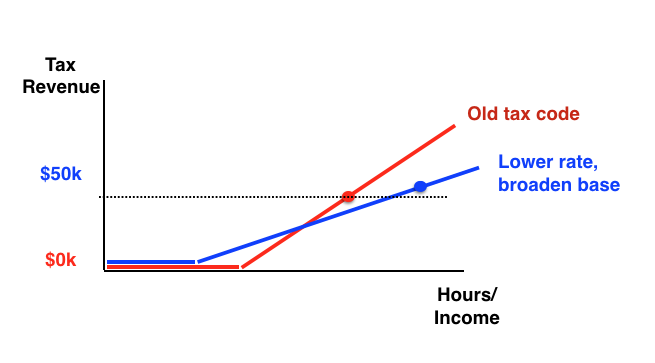
If we broaden the base, and lower the rate, we increase incentives to work. Then, to raise the same revenue, we don't have to make the lines cross at the old revenue. The new line can lie below the old line at the old work effort, but greater growth will make up the revenue, as shown.

The argument is not whether "tax cuts pay for themselves." That's an extreme possibility. But tax rate cuts do partially pay for themselves, so one can raise the same revenue from a tax system that appears, on static scoring (ignoring that the points move to the right) to raise the deficit instead.

This argument is correct, but it leads to a huge fight over just how much growth will increase, and when. It is hard to quantify. It is especially hard, in my view, because most government analysis ignores all the important channels. We focus on labor effort. But once we have chosen careers and jobs, most people work the same amount. The damage is more insidious. Slowly, people drop out of the labor force. Slowly, people chose easier college majors. Slowly, people choose safe and steady but not well paying jobs rather than risky high reward business startups. Slowly, people invest in  complicated lawyer-intensive tax-avoidance strategies. This all takes time.

And we have a huge deficit. So, I would prefer not to fight this argument. Broaden the base and lower the rates on static scoring. When money starts roaring in, cut the rates. Agree on the structure of the tax code for a generation, and let rates adjust as needed. Yes, many readers will worry that lots of revenue will lead to lots more spending. OK, let's write in that rates go down further if and when the revenues increase, rather than cut them now.

Furthermore, if we had to make a revenue-neutral reform, I think the pressure to get rid of the deductions would be much stronger. These mostly benefit the rich anyway (class warriors, why are you so silent on the regressive effects of home mortgage, charitable, employer health care, and state and local deductions??) You just can't get significant rate reductions on a revenue neutral basis without really cutting the deductions, tax expenditures, and with them much of the complexity and corruption of the code.

Alas, this eminently sensible idea -- broaden base, lower marginal rates, redistribution-neutral, and revenue-neutral, growth-oriented reform -- does not characterize much of what I'm hearing about the upcoming personal income tax changes.

One thing we are hearing more of is expanded deductions, for example for child care.  This is supposed to give a "tax cut to the middle class." Well, again, a tax cut and a marginal tax rate cut are entirely different things, and have different effects on growth.

The next graph gives the "middle class" a "tax cut" in two different ways -- by lowering the marginal rate, or by offering a new deduction or credit, and keeping the old rates intact. At the blue dot, our taxpayer has received the same "tax cut." But notice that by adding a deduction, we have done nothing to improve our taxpayer's incentives. In fact, we have made matters worse. There are offsetting "income" and "substitution" effects in provoking effort. As we get wealthier, we choose to work less. As opportunities are larger, we work more. This is all income effect, and no substitution effect.

It gets worse. The budget impact of this deduction is obviously large. Everybody in the US gets the deduction, all the way up the income scale. For that reason, most of these deductions phase out. Sure, "gazillionaires don't need help with their childcare expenses." (A good example of bad economic thinking all around.) So the credit phases out. The next graph shows what happens if we add a deduction or credit that phases out with income:


The steepest part of the line -- the greatest disincentive to work -- is in the phaseout region. In fact, the Americans facing the highest marginal tax rates are those precisely in the "middle class," where earning an extra dollar phases out credits, health insurance subsidies, food stamp subsidies, and so forth. On average, pretty much from 0 to $60,000 there is very little incentive to work -- or, again, to study, to choose harder professions, to move to take a job, to start a business and so on.

This is a little bit unfair. The credits and deductions do have incentive effects. That's half of why they're there. The mortgage interest deduction gives people an incentive to buy rather than rent, to borrow rather than save, to buy bigger rather than smaller, and to refinance frequently. (Interest payments are tax deductible, principal payments are not.) The childcare credit gives people an incentive to have children. (That this incentive is inversely scaled with income is another interesting issue.) The health care deduction encourages us to spend a lot more on health insurance and less on solar cells and electric cars. The solar cell and electric car deduction encourages us to spend more on those and less on food. And so forth.  If these activities encourage economic growth, perhaps it's worth suffering the disincentive to work, study, save, or start businesses.

An honest economist must admit that for economic growth, taxes do not matter. Marginal tax rates matter.  If there were a way to "tax the rich" without raising the disincentive to all the socially useful activities that becoming rich, or working to pass wealth on to your children entails, and if our society decided it wanted such redistribution, we would have much less argument against it. We would do the world a favor, I think, to harp most on incentives, which the world seems to ignore, and much less on our personal moral feelings about redistribution, pro or con.

How high are our marginal rates? Another important principle: All taxes matter, not just federal income taxes, and benefit phaseouts are just as important as actual taxes. Add to the Federal 43% top marginal rate the state income tax -- 13.5% in my California -- plus sales taxes on everything you buy -- 9% in lovely Palo Alto. Pundits' habit of only quoting the federal income tax in isolation is profoundly wrong. And if you're one dollar below the medicaid cutoff, you face an essentially infinite marginal tax rate.